Why Symbol Choice Matters More Than Size
A 2cm symbol sits on your skin every day. You'll catch it in mirrors, in photographs, in the half-second glance you give your own wrist while reaching for a coffee cup. That kind of daily exposure demands something earned, not something chosen quickly because it looked good on a reference board.
Minimalist tattoo work strips away the contextual clues that larger pieces rely on. A photorealistic portrait has shading, depth and narrative detail to carry its message. A small symbol has none of that. The shape itself does all the work.
That's both the appeal and the challenge. Get the symbol right, and it reads with quiet authority for decades. Get it wrong, and there's nowhere to hide.
Geometric Symbols: Shape as Language
Geometric forms have been used as symbolic shorthand across cultures for centuries. They work in minimalist tattoo work because they're already built from clean lines and defined proportions. There's no translation required between concept and mark.
Circle and the Ouroboros
The circle is probably the most cross-cultural symbol you can choose. It appears in Buddhist, Greek, Celtic and Islamic visual traditions without contradiction. In tattoo form it reads as wholeness, continuity, or the absence of beginning and end.
The ouroboros, a serpent eating its own tail, extends that meaning into something more dynamic. It introduces the idea of cycles and self-renewal. At small scale, the serpent's detail needs to be simplified significantly, which is where a skilled fineline hand earns its keep.
Triangle and Its Orientation
Point-up and point-down are not interchangeable. A triangle pointing upward draws on associations with fire, aspiration and the masculine principle in alchemical tradition. Flip it, and you shift toward water, introspection and the feminine principle. That's a significant change for one small rotation.
If you're considering a triangle, know which one you mean before the consultation. The artist will ask.
Infinity, Sacred Geometry and the Seed of Life
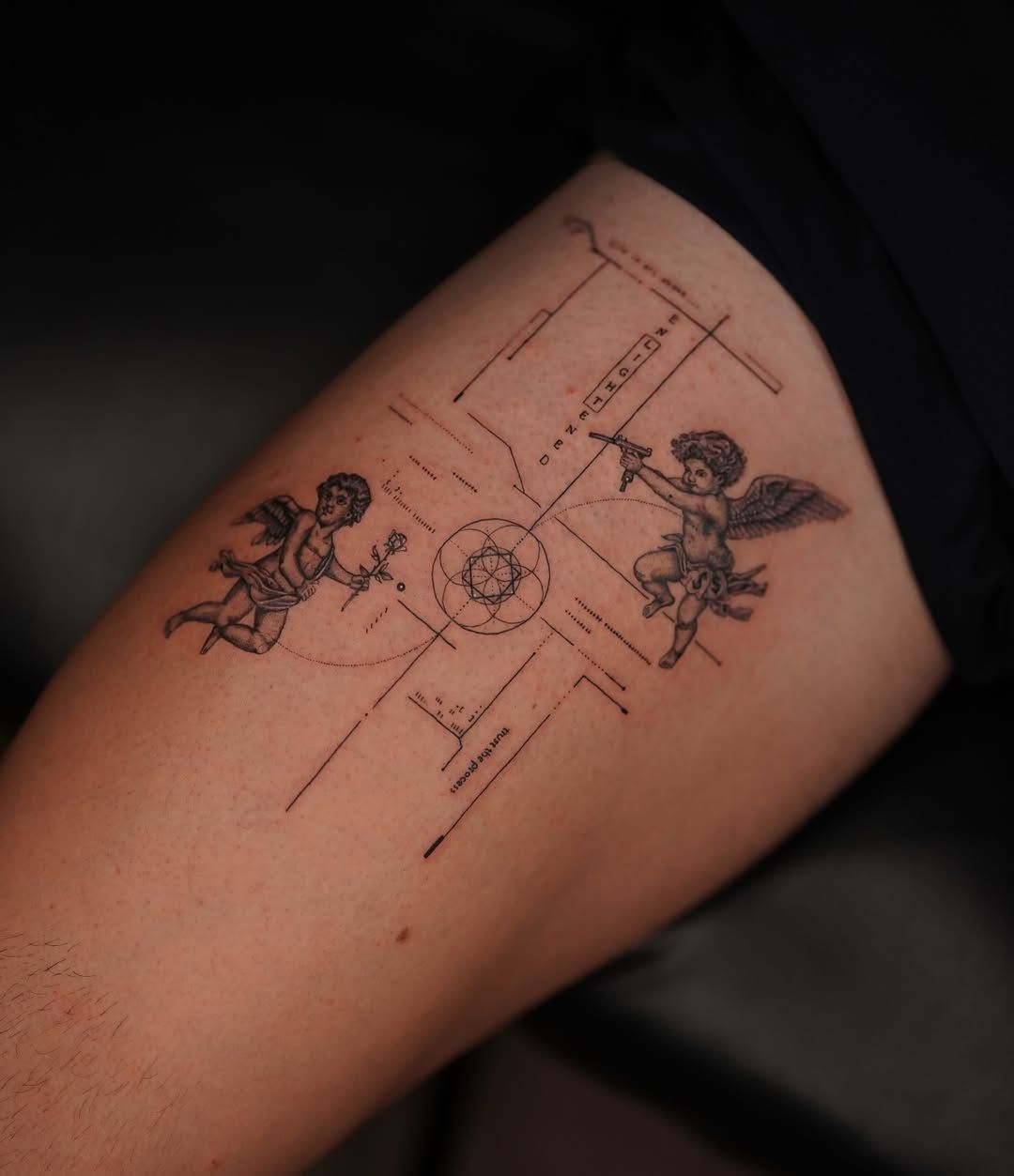
The infinity loop is one of the most requested small tattoo symbols, and it holds up well at scale because the form is simple. Sacred geometry goes further, drawing on mathematical relationships found in natural structures. The Seed of Life, seven overlapping circles forming a flower-like pattern, echoes the azulejo tile traditions you'll see across Alfama and Mouraria. For clients already living in Lisbon, that resonance is built-in.
For a deeper look at how these patterns translate into body art, the studio's guide on types of geometric tattoos explains each family of forms in detail.
Botanical Symbols: Flowers and Plants That Say Something Specific
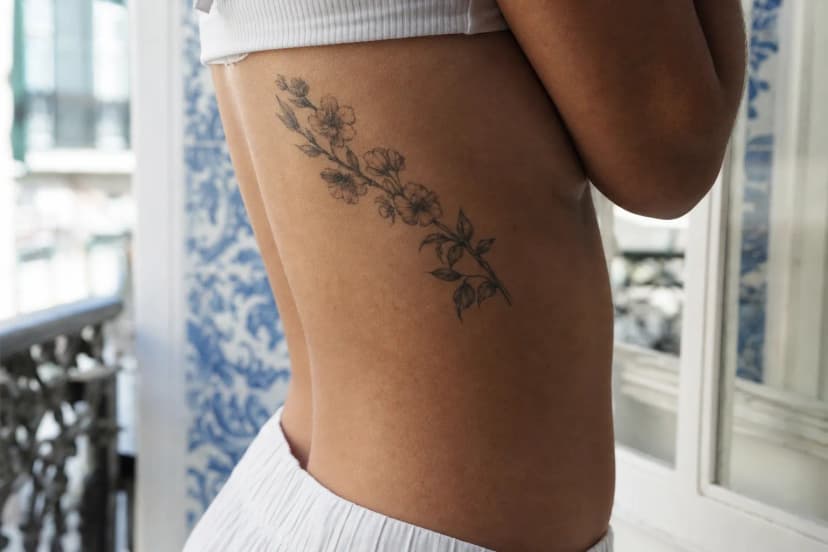
Botanical imagery carries a layered visual language that European and Mediterranean cultures have developed over centuries. It's not vague. A rose bud, a full bloom and a wilting head each mean different things. The difference between choosing lavender and choosing a peony is the difference between lightness and weight.
The Rose and Its Stages
A closed bud suggests potential, something not yet revealed. A full bloom is abundance, love at its peak. A drooping or dying rose carries loss and impermanence. These distinctions matter in small tattoo symbols and meanings precisely because there's no accompanying detail to explain which reading you intend. The stage of the flower does that work alone.
Wildflowers vs Cultivated Blooms
Lavender, chamomile and wild daisy carry a lighter energy. They're informal, connected to open fields and the natural world without ceremony. Cultivated blooms like the peony, lotus or magnolia carry more gravity. The lotus in particular arrives with centuries of Buddhist and Hindu meaning attached, suggesting purity or spiritual emergence.
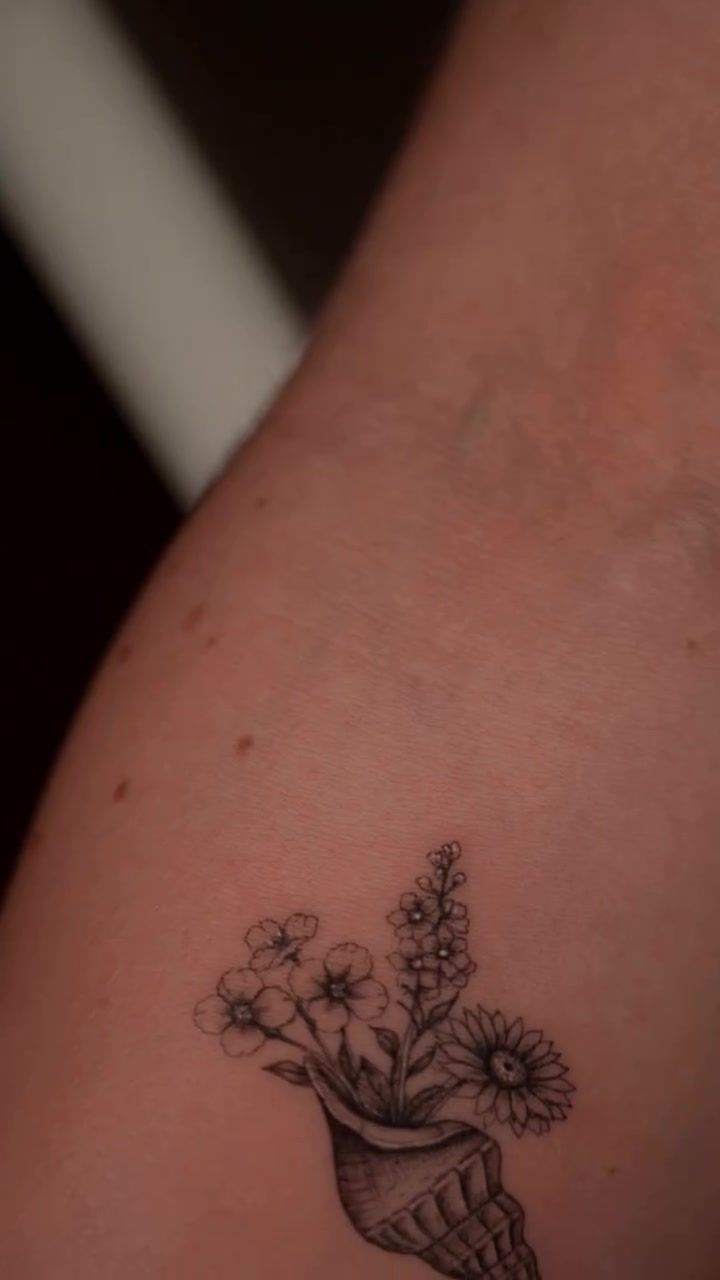
The Conch Shell in Bloom piece in the portfolio shows how botanical and natural forms can be woven together in fineline work, retaining delicacy without losing clarity.
Olive Branch, Laurel and Mediterranean Roots
For clients in Lisbon and across Portugal, the olive branch and laurel wreath carry particular cultural weight. The olive branch is one of the oldest peace symbols in the Mediterranean world, rooted in Greek and Roman tradition. The laurel, worn by Roman emperors and Olympian athletes alike, speaks to achievement and recognition. Both translate beautifully into small symbolic minimalist tattoo designs because their forms are already elegant at reduced scale.
Explore the range of botanical and floral tattoo designs the studio works with to see how these motifs translate across different placements and sizes.
Classical and Mythological Symbols
Greek and Roman imagery has never really left the tattoo canon. But in minimalist form, these symbols drop the grandeur and keep the idea. That restraint is what makes them work as small meaningful tattoo ideas.
Memento Mori Motifs
The skull and hourglass are memento mori symbols, a Latin phrase meaning "remember that you will die." That sounds dark. But the tradition behind it isn't morbid; it's a philosophical tool for living more deliberately. Stoics in ancient Rome used the same reminder. In minimalist tattoo form, a small hourglass or simplified skull reads as intentionality, not doom.
The studio's Memento Mori Angel Back Tattoo shows how this symbolism can be handled with restraint and craft, avoiding the heavy-handedness that ruins lesser versions of the motif.
The Eye and the Anchor
The eye, particularly as the Eye of Providence or the Nazar, carries protective associations across Mediterranean, Middle Eastern and Western esoteric traditions. It's compact by nature and holds its form well at small scale. The anchor has both nautical and Stoic roots. In port cities like Lisbon, the anchor has an obvious resonance with maritime history and the Age of Discovery. Philosophically, it suggests steadiness under pressure. Both readings are valid, and neither cancels the other.
Celestial Symbols: Moon, Sun, Stars
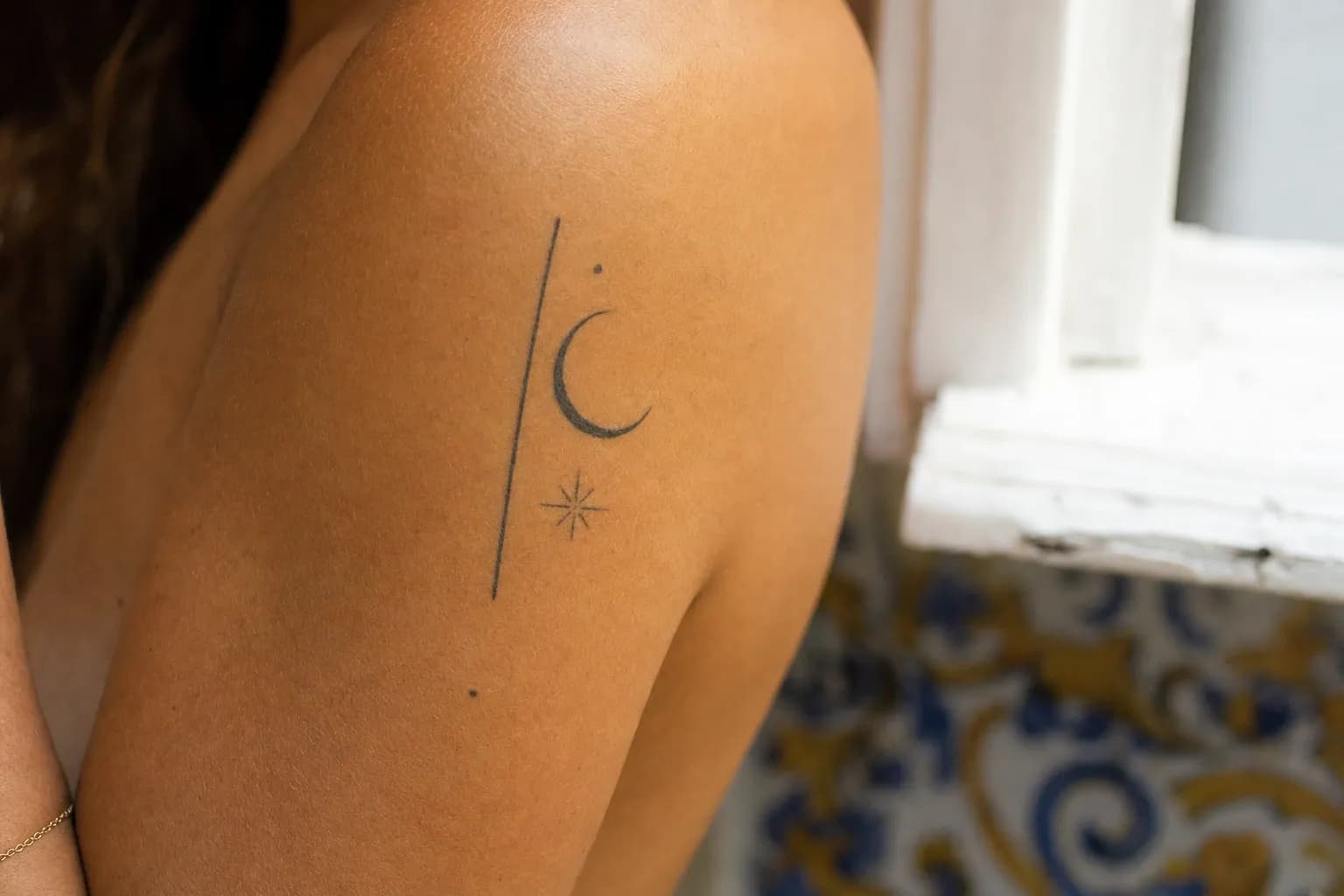
A crescent moon, a full circle sun and a single five-pointed star each carry distinct connotations. The crescent is associated with cycles, intuition and change. The sun with clarity, energy and the conscious mind. A lone star often reads as guidance or aspiration. Tiny tattoo symbols in this category are among the most popular requests, and for good reason: their forms are simple enough to survive at very small scale without losing legibility.
Lettering as Symbol: Single Words, Letters and Glyphs
A single letter, reduced to its most essential graphic form, functions as a symbol. It carries meaning the way a monogram does: compact, personal, immediately legible to some and opaque to others. That privacy is often the point.
Rune characters from Nordic tradition, alchemical glyphs and geographic coordinates all fall into this category. They're minimalist symbol tattoo designs that encode something specific without broadcasting it. A set of coordinates for a place that changed your life reads as abstract decoration to most viewers. To you, it's precise.
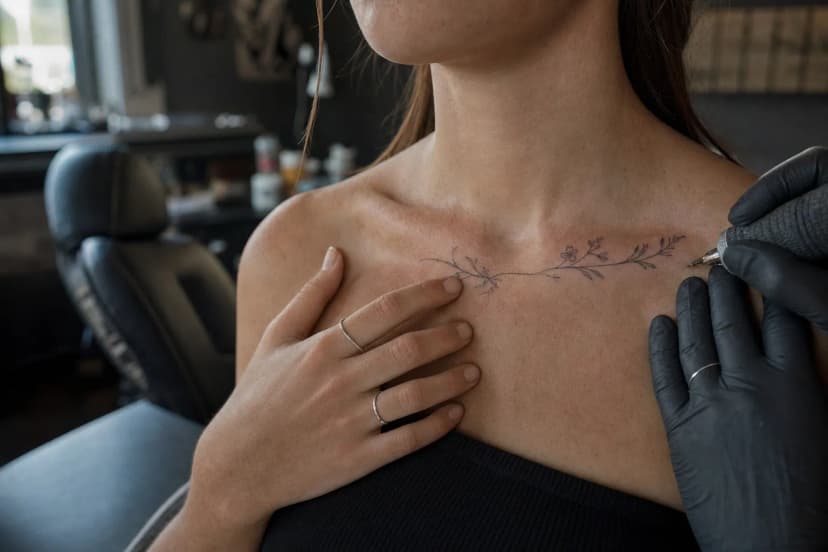
Placement reshapes how these glyphs read. Behind the ear suggests something intimate, barely shared. The inner wrist is more open, more visible. The collarbone sits at the edge of what's public and what's private, depending on what you're wearing. For a full breakdown of how placement affects symbolic reading, the studio's guide on where to place a minimalist tattoo is worth reading before you decide.
How the Studio Approaches Symbol Tattoos
The first question in a consultation isn't "what does it look like?" It's "why this one?" Understanding the reason a client has chosen a particular symbol changes how it gets designed. A triangle chosen for its alchemical meaning sits differently on the body than one chosen because it's visually clean. Both are valid. But the placement, orientation and weight of the line can reinforce the intention, or quietly work against it.
Scaling is a technical matter that catches people off guard. A symbol that looks balanced at 5cm on a screen may fall apart at 2cm on skin. Simple geometric forms generally hold from around 1.5cm. Symbols with interior detail, like a Seed of Life or a detailed laurel wreath, usually need at least 3cm to remain legible after healing.
"If the stencil sits 1mm off-centre on a small circle, you will see it every single time you look at the piece. Precision at this scale is non-negotiable."
Stencil accuracy on simple shapes is more demanding than on complex ones, not less. A circle drawn 1mm off-centre is immediately visible because there's nothing else to draw the eye. The artist checks stencil position multiple times before beginning, and clients are encouraged to look at it from different angles and different distances before confirming.
Lisbon's humid summers also affect the immediate aftercare protocol. In July and August, the warm, moist air changes how a fresh small tattoo breathes under its initial wrap. The studio adjusts accordingly, and your aftercare instructions will reflect the season. For general guidance on what your skin needs after leaving the studio, the aftercare guidance for small tattoos covers the essentials clearly.
Placement and Sizing: Making the Symbol Work on Skin
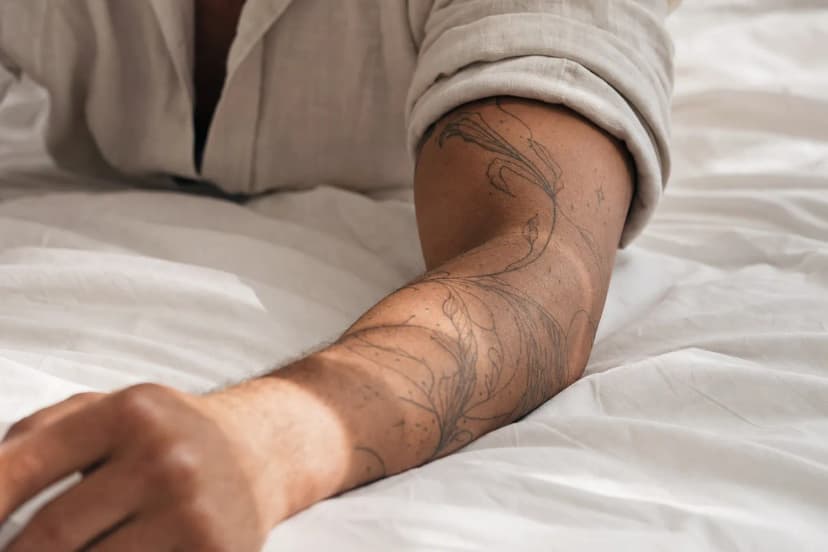
Skin moves. Around the knuckles, the wrist joint and the inner elbow, that movement is constant and significant. Fine geometric outlines placed over high-movement areas will distort over time as the skin stretches and contracts. This isn't a scare story; it's a planning consideration. The studio will flag any placement that works against a symbol's geometry during consultation.
For a broader look at how placement decisions affect small pieces across multiple styles, the studio's article on tattoo locations for small tattoos covers the logic in practical detail.
- Inner wrist: low movement, good visibility, holds fine lines well over time
- Upper arm / outer forearm: stable skin surface, excellent for geometric and botanical symbols
- Behind the ear: intimate placement, suits single glyphs and small celestial symbols
- Collarbone: flat surface, ideal for horizontal forms like a laurel or coordinate string
- Sternum / upper chest: low friction, works well for circular symbols and mandalas
- Ankle: moderate movement, choose simpler forms without fine inner detail
- Finger / knuckle: high movement and sun exposure, expect faster fade and distortion
| Symbol | Minimum recommended size | Best placements | Avoid |
|---|---|---|---|
| Simple circle | 1.5cm | Inner wrist, forearm, sternum | Knuckles, fingers |
| Triangle (outline only) | 1.5cm | Upper arm, collarbone, ankle | Over joints |
| Infinity loop | 2cm wide | Inner wrist, forearm, behind ear | Sides of fingers |
| Seed of Life / sacred geometry | 3cm | Sternum, upper arm, thigh | High-friction zones |
| Single botanical stem | 2cm tall | Forearm, collarbone, behind ear | Palms, inner fingers |
| Crescent moon | 1.5cm | Wrist, ankle, behind ear | Knuckles |
| Anchor | 2.5cm | Forearm, upper arm, calf | Sides of hands |
| Laurel wreath | 4cm | Upper arm, thigh, sternum | Wrist, ankle |
| Single rune / glyph | 1.5cm | Behind ear, inner wrist, collarbone | Fingers |
| Coordinate text | 5cm wide | Collarbone, forearm, ribcage | Curved surfaces at small scale |
One note on skin tone and healing. As ink settles into the dermis over six to eight weeks, lines consolidate slightly. At very small scale, fine parallel lines placed too close together will merge into a single thicker mark. The artist accounts for this during design, leaving slightly more space between elements than looks right on paper. It looks right on healed skin.
- Decide on the symbol and understand what it means to you specifically, not just culturally.
- Research placement options before your consultation, using the sizing table above as a starting point.
- Bring reference images of the symbol in different sizes and orientations. Not just one pin.
- Ask the artist about stencil placement before committing; look at it standing, sitting and with your arm in its natural resting position.
- Plan your aftercare in advance, especially if your session falls in Lisbon's humid summer months.
Frequently Asked Questions
What is the most universally understood small tattoo symbol?
The circle is probably the most cross-cultural symbol you can choose. It appears in Buddhist, Greek, Celtic and Islamic visual traditions without contradiction. In minimalist tattoo form, it reads as wholeness or continuity. Because it's so simple, execution needs to be precise. A circle drawn poorly at small scale is immediately obvious.
How small can a symbol tattoo go and still keep its shape after healing?
Most solid geometric symbols hold well from about 1.5cm across. Below that, fine inner lines begin to fill in as the ink settles into the dermis over six to eight weeks. A skilled fineline artist working with a single needle can push smaller, but the simpler the symbol, the better it survives at tiny scale.
Do small symbol tattoos fade faster than larger ones?
Size alone doesn't determine fade rate. Placement matters far more. Symbols on hands, fingers or the sides of feet see constant friction and sun exposure, which breaks down pigment faster. A small symbol on the inner wrist or upper arm, kept out of direct sun and moisturised regularly, can hold its shape for many years.
Which symbols work best as minimalist fineline tattoos?
Geometric forms. Circles, triangles, the infinity loop. Work naturally because they're already defined by clean lines. Botanical symbols like a single stem or leaf also suit fineline well. Symbols with heavy fill or complex shading, like a detailed coat of arms, are harder to reduce without losing legibility at small scale.
Can I combine two symbols in one small tattoo without it looking cluttered?
Yes, but the two symbols need visual logic between them. Stacking a crescent moon above a single line, for instance, uses negative space to let both read clearly. Trying to nest unrelated symbols at small scale usually results in one cancelling the other. The consultation is where this gets worked out properly, before any needle touches skin.