Why Botanical Tattoos Are One of the Most Technically Demanding Styles
The difference between a botanical illustration and a tattoo
Open any 18th-century plant encyclopaedia and you'll see the tradition this style draws from: meticulous ink illustrations of stems, petals, seed pods, and root systems, each line placed with scientific intention. Tattoo artists working in botanical styles are attempting something in the same spirit. But skin is not paper, and that difference changes everything.
Paper holds a line exactly where it lands. Skin moves, stretches, breathes, and heals. The ink has to be deposited at a consistent depth into the dermis (the layer beneath the surface skin) to stay there long-term. Too shallow and it fades in months. Too deep and the line blows out, spreading into the surrounding tissue like ink dropped on wet paper. A skilled floral tattoo service sits right in that narrow window, every pass of the needle.
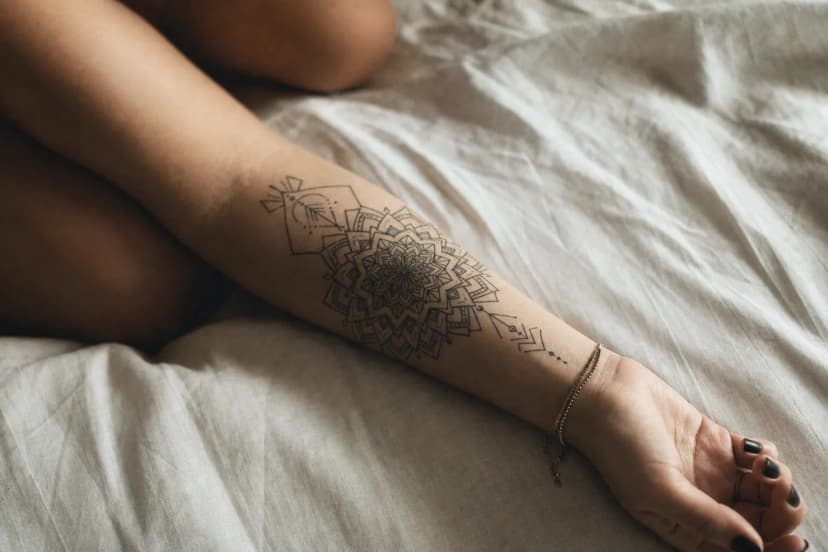
Botanical work also has no geometric grid to fall back on. Mandalas and sacred geometry rely on repetition and symmetry to self-correct small errors. An asymmetric wildflower composition doesn't. If a stem curves wrong or a leaf sits at the wrong angle, there's nowhere to hide it.
Why so many floral tattoos blur within a few years
Line spacing. That's usually the answer. When two lines are placed too close together, they look crisp on day one. But over three to five years, the ink migrates slightly outward in the dermis. The lines merge. What was a delicate petal outline becomes a soft grey smudge.
"Negative space is not empty space. In a botanical piece, the gaps between lines are doing as much work as the lines themselves. Collapse that gap and you've collapsed the design."
This is why what fine line tattooing actually requires goes well beyond a steady hand. The artist has to design with time in mind, building in enough breathing room that the piece still reads clearly a decade later.
What Makes a Botanical Tattoo Design Actually Work
Choosing the right plants and compositions
Not every plant translates to skin at every scale. Fine-petalled flowers like anemones, cosmos, or wildflowers with delicate stamens can look extraordinary on a forearm. Dense tropical leaves with complex vein structures often collapse into a muddy green-grey at anything smaller than a hand's width. A good botanical tattoo design starts with an honest conversation about what will actually hold.
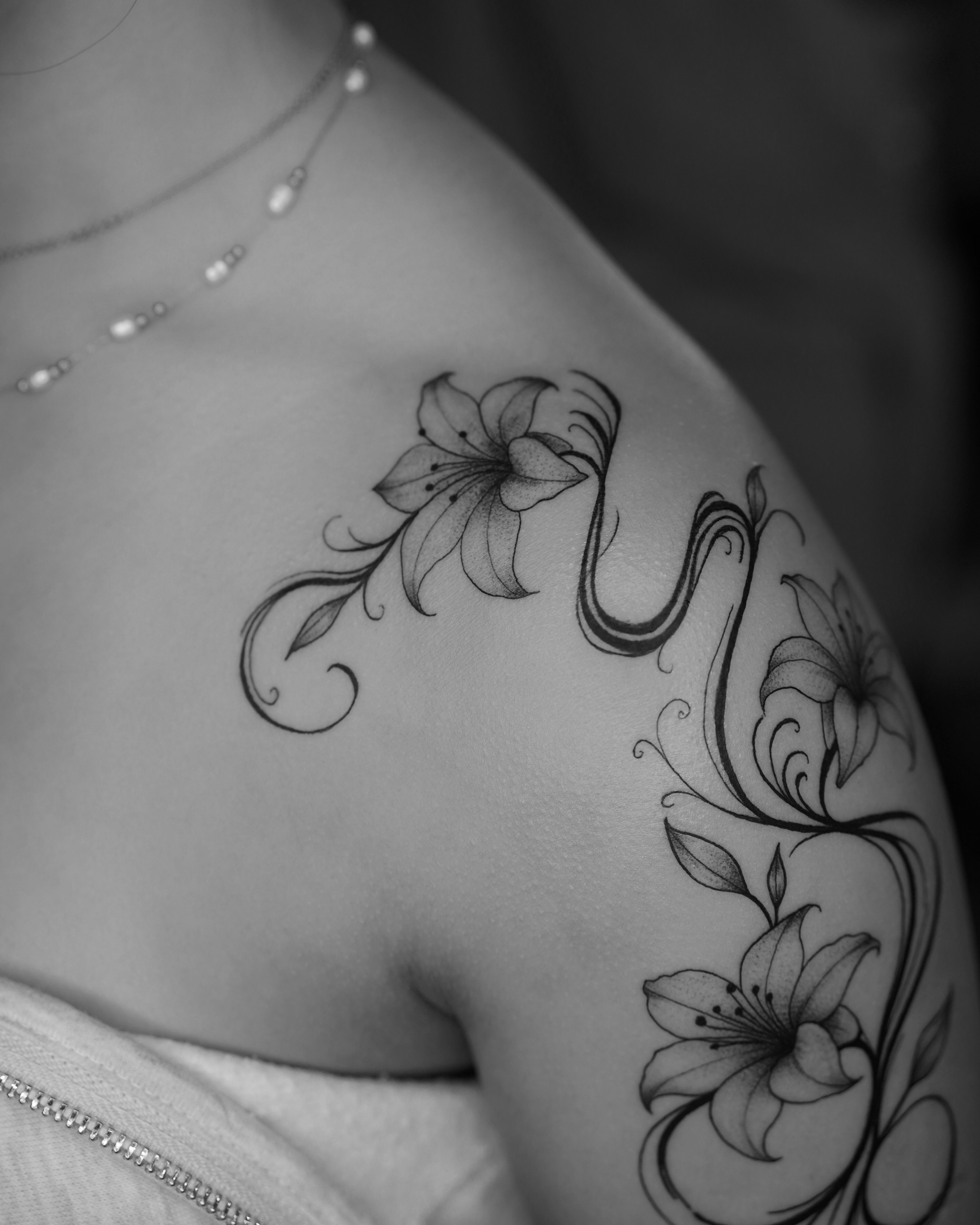
Negative space does at least half the work in any strong botanical piece. The white of the skin between petals creates the illusion of depth and light. Pack the design too tightly and that illusion disappears. The result looks heavy, not lush.
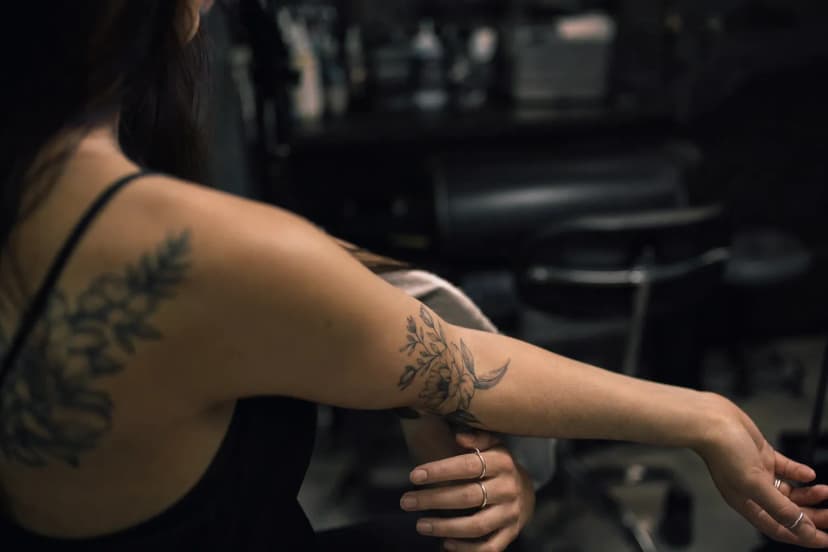
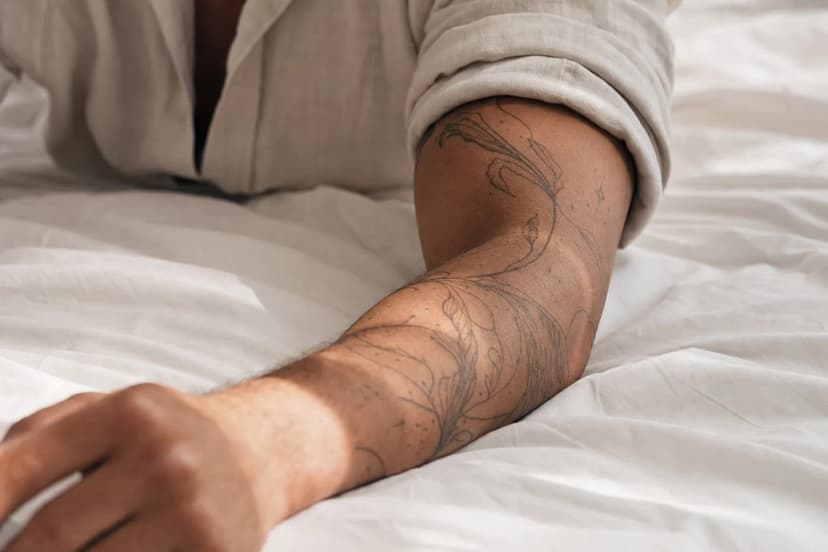
Composition matters too. A single-stem wildflower tattoo reads naturally on a forearm because the limb's vertical orientation mirrors the plant's growth direction. A radial arrangement of leaves and blooms suits a shoulder blade, where the rounded canvas gives the design room to spread outward from a centre point.
Scale, placement, and the anatomy of the body
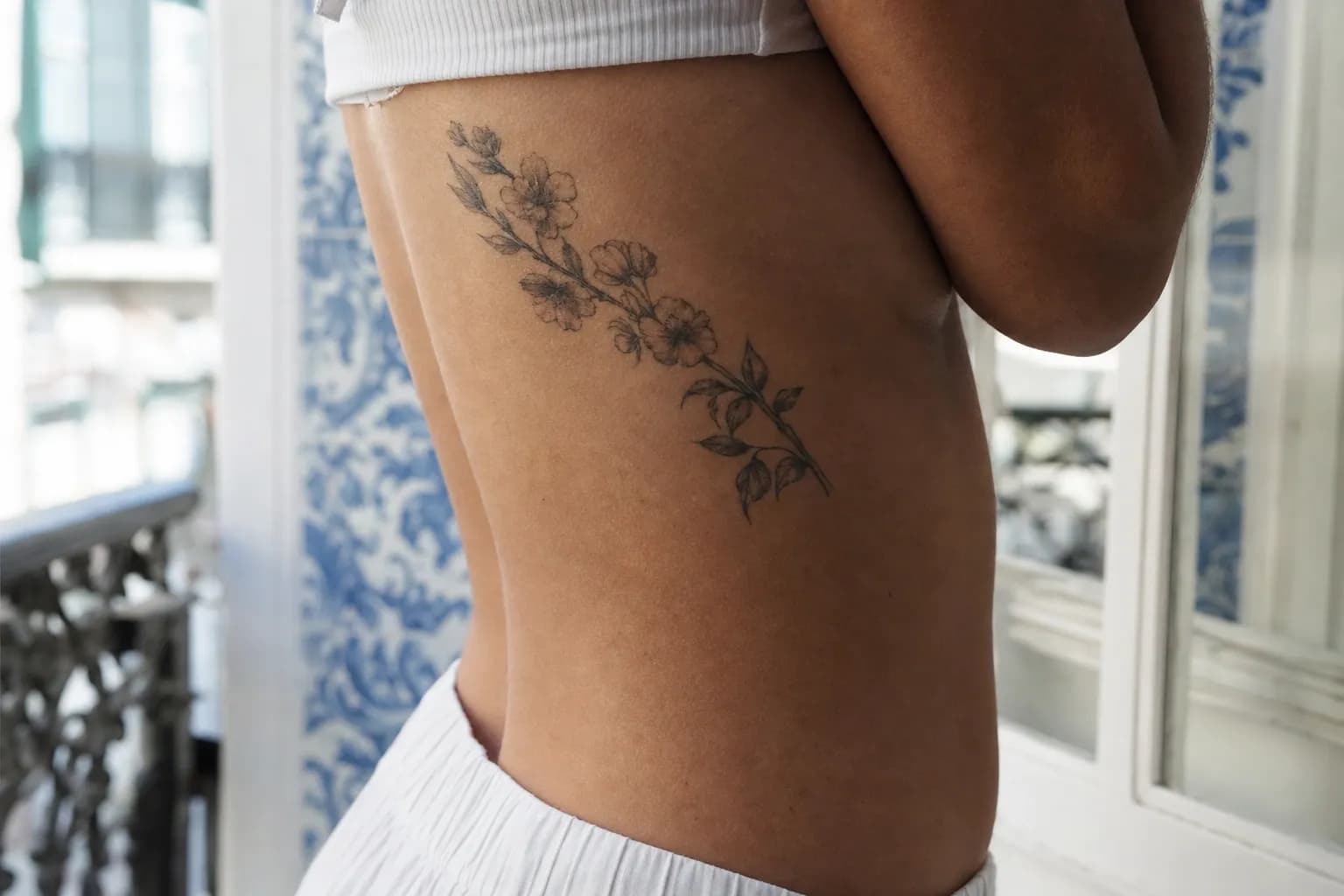
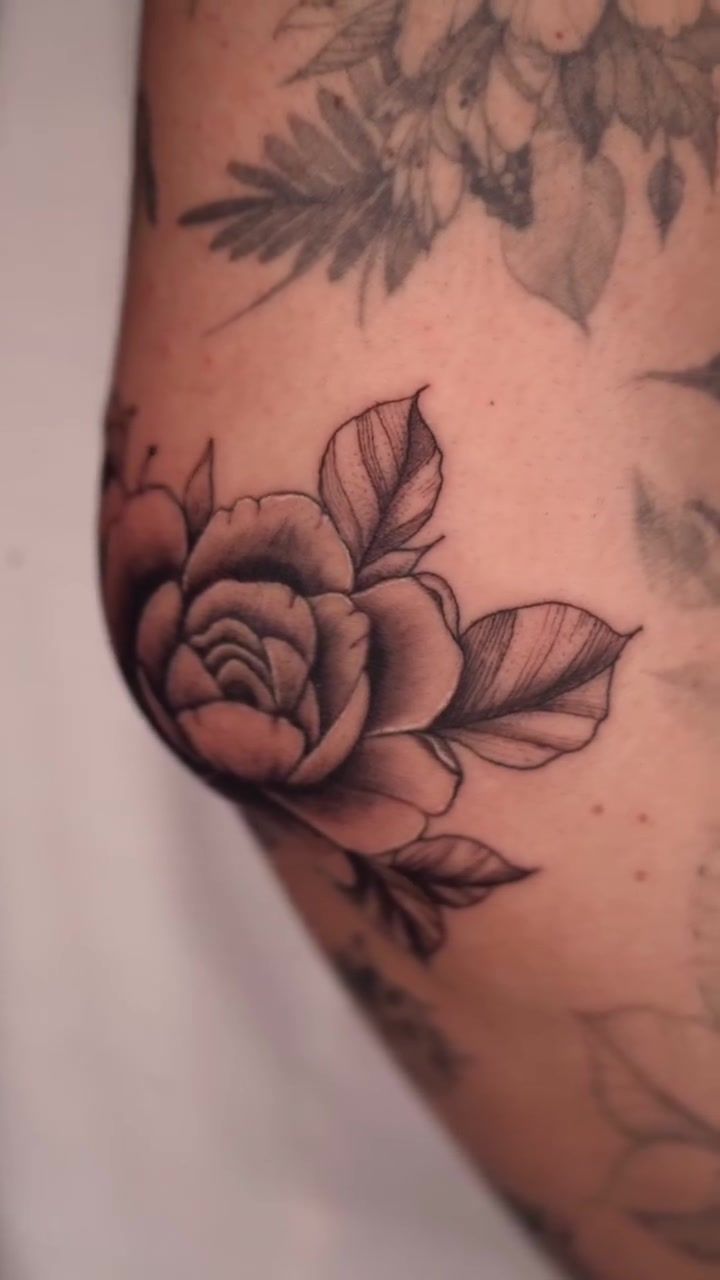
Placement affects how a piece ages as much as technique does. The inner forearm has thinner, more consistent skin than the outer forearm and tends to hold fine lines cleanly. The wrist and elbow crease are high-movement areas; skin there flexes constantly, which can distort fine linework over time. The ribcage and thigh offer more stable, flat surfaces for complex botanical arrangements.
Size and placement also interact with Lisbon's sun exposure. A shoulder piece that spends every summer under direct Atlantic light will fade faster than one tucked on the inner upper arm. That's worth factoring in before you commit to a placement.
How the Studio Approaches Botanical Work
The consultation and reference process
The studio's two core specialisms are fineline work and botanical design. Those two things overlap almost completely in this style. A wildflower tattoo in fineline is precisely where both sets of skills are needed at the same time.
Clients are encouraged to bring real references. Not just saved images from social media, which often show healed photographs taken under flattering light. Pressed flowers, pages from illustrated botanical books, even photos of plants growing in your own garden. These give the artist specific information about the species you care about and how you see them.
The design is then sketched for your body, not pulled from a flash sheet. Body proportions vary enough that a composition drawn for one person's forearm will sit wrong on another's. The artist maps the design to your specific placement during the consultation, accounting for the width of the limb, the curve of the muscle beneath, and where natural shadows fall.
For guidance on what to look for when choosing who to work with, the article on what to look for in a floral tattoo artist in Lisbon covers portfolio evaluation, red flags, and realistic expectations in detail.
Fineline and micro realism within botanical designs
A rose petal at 4cm wide needs at least three distinct tonal values to read as three-dimensional: a highlight, a midtone, and a shadow. Achieving that at small scale is micro realism territory, not pure fineline. The two styles intersect constantly in botanical work.
When a single leaf needs to show veining, surface texture, and the slight translucency of light passing through it, the artist is blending single-needle linework with precise stippling and soft shading. That combination requires a different needle configuration and a different hand speed than flat linework. Knowing which tool to switch to, and when, is craft knowledge built from repetition on skin.
The studio is based in Lisbon, within easy reach of Príncipe Real and Cais do Sodré by metro. Consultation slots are limited; the studio doesn't rush the design stage, and that means available appointment windows fill up several weeks ahead.
Healing Botanical Tattoos in Lisbon's Climate
Summer humidity and what it means for aftercare
Lisbon runs humid between June and September. The Atlantic air keeps temperatures from baking, but it also means that healing skin tends to stay moist longer than it would in a drier climate. That sounds helpful. It can actually complicate things.
Excess moisture on healing skin encourages the outer layer to soften and peel unevenly. In a bold tattoo, uneven peeling shows up as patchy saturation. In a fine line botanical piece, a single bad peel can lift a hairline stem entirely. The difference between a wildflower tattoo fineline piece that heals perfectly and one that needs a touch-up often comes down to those first ten days of aftercare.
Practical aftercare steps for fine line floral work
The studio provides written aftercare instructions at every appointment, but these are the core principles for botanical work specifically:
- Wash the tattoo twice daily with a fragrance-free, pH-neutral soap. Lather gently with clean hands, rinse with cool water, pat dry with a clean paper towel.
- Apply a thin layer of unscented moisturiser (fragrance-free lotion or a product recommended by your artist) two to three times a day. Thin is the word. A thick layer traps moisture and can cause ink to lift.
- Keep the piece out of direct sunlight for a minimum of four to six weeks. Lisbon's summer sun is strong enough to fade fresh ink in a single afternoon on the beach.
- Avoid swimming in the ocean. The Cascais coast and Costa da Caparica are tempting in summer, but saltwater and fine line work don't mix during healing. Wait at least three weeks, and ideally until the skin feels completely normal.
- Wear loose cotton clothing over healing shoulder or back pieces. Synthetic fabrics can stick to weeping skin and pull during removal.
Surface skin typically closes within two weeks. But the ink continues settling into the dermis for six to eight weeks after that. Touch-up appointments, if needed, should be booked no sooner than eight to ten weeks after the original session. Booking earlier risks working on skin that is still adjusting.
Practical Guide: Planning Your Botanical Tattoo
Size and session length
Botanical tattoos vary enormously in scope. A small plant tattoo. A single sprig of rosemary or a delicate fern frond at wrist scale. Might take ninety minutes. A palm-sized composition with multiple blooms and leaf clusters will typically run two to three hours. A half-sleeve incorporating several botanical elements across the forearm and upper arm could require three or four separate sessions spaced eight to ten weeks apart.
| Approximate Size | Estimated Session Time | Recommended Placements |
|---|---|---|
| Small (5-8 cm) | 1-1.5 hours | Wrist, ankle, behind the ear, collarbone |
| Medium (10-15 cm) | 2-3 hours | Forearm, inner upper arm, calf, shoulder |
| Large (18-25 cm) | 3-5 hours | Shoulder blade, thigh, ribcage, full outer arm |
| Statement / Sleeve segment | Multiple sessions (3-4+) | Full forearm, half-sleeve, back panel |
These are working estimates. A design with dense shading and multiple tonal values takes longer than a pure linework piece of the same physical size. The artist will give you a clearer session estimate once the design is finalised at consultation.
What to bring to the consultation
The more specific your references, the more precise the design conversation can be. Vague requests produce generic results. Here's what to prepare:
- Reference images. Aim for variety: botanical illustrations, healed tattoo photographs (not fresh ones), even close-up photos of real plants. Save them somewhere accessible on your phone.
- A reason for the plants you've chosen. You don't need a dramatic story. But knowing whether a plant has personal significance, or whether you simply love its visual structure, helps the artist understand the emotional register the piece should sit in.
- Knowledge of your skin tone. On olive or darker skin, very light grey shading can disappear entirely once healed. The artist will adjust the tonal range accordingly, leaning on stronger contrast and slightly heavier linework. The botanical style still works. The approach just shifts.
- Clothing that exposes the placement area easily. If you're planning a shoulder piece, wear a vest top or a loose shirt that drops off the shoulder. For a thigh piece, bring shorts. It sounds obvious, but arriving in a high-neck fitted top for a collarbone consultation costs everyone time.
Frequently Asked Questions
Do botanical tattoos age well on skin?
They can, but line spacing is the deciding factor. Lines placed too close together will merge as the ink settles over years. A considered botanical tattoo design leaves deliberate negative space between petals and stems, so the piece stays legible a decade later rather than collapsing into a grey wash.
What is the difference between a floral tattoo and a botanical tattoo?
Floral usually means any flower-based design, including stylised or decorative interpretations. Botanical implies a more illustrative, naturalistic approach. Accurate leaf shapes, root structures, seed pods. Closer to a scientific plant illustration. In practice the two overlap heavily, and most clients use the terms interchangeably.
Can botanical tattoos work on olive or darker skin tones?
Yes, though the approach shifts. On deeper skin tones, very light grey shading can disappear, so the artist leans on stronger contrast and slightly heavier linework. The botanical style still works beautifully; it just requires a more considered approach to tonal range during the design and execution stages.
How do I choose which plants to include in my botanical tattoo?
Personal meaning is a good starting point: a plant from your grandmother's garden, a wildflower from a place that matters to you. From there, an experienced plant tattoo artist will advise on which species translate well at your chosen size and placement, since some fine-leafed plants simply don't hold detail below a certain scale.
How long does a botanical tattoo take to fully heal?
Surface skin typically closes within two weeks, but the ink continues settling into the dermis for six to eight weeks. Fine line botanical work in particular should be kept out of direct sun for the full healing period, and any touch-up appointments should be booked no sooner than eight to ten weeks after the original session.