Why Geometry Has Always Carried Meaning
Long before anyone sat in a tattoo chair, humans carved geometric forms into stone, painted them on cave walls, and wove them into temple architecture. The Egyptians built pyramids around precise mathematical ratios. Islamic craftsmen spent lifetimes perfecting repeating geometric tilework. Here in Lisbon, the azulejo tile tradition produced intricate geometric patterns that still line the walls of Alfama staircases and Príncipe Real courtyards.
Geometry keeps appearing across unconnected cultures because certain shapes feel universal. A circle needs no translation. A spiral is the same word in every language.
That universality is part of why geometric tattoo symbolism appeals to so many people who wouldn't consider a culturally specific figurative design. The shapes carry weight without belonging to any single tradition. And the meaning, while rooted in shared human history, is always finished by the person wearing it.
What the Most Common Shapes Actually Represent
Circles and rings
A circle has no start and no end. That's not poetic shorthand; it's geometric fact, and it's why circles have been used across Buddhist, Celtic, and Islamic traditions to represent wholeness, continuity, and the cycle of existence. As a tattoo, a single clean circle can say more than a paragraph of text.
Rings stacked or nested inside each other amplify the idea of cycles within cycles. The geometric tattoo meaning shifts subtly depending on whether the circle is open, closed, or interlocked with another.
Triangles
Direction matters enormously with triangles. Pointing upward, a triangle traditionally links to fire and masculine energy. Drive, ambition, forward momentum. Pointing downward, it connects to water and receptive, feminine energy. Both readings come from classical elemental systems that pre-date modern Western esotericism by centuries.
On the body, a triangle's placement sharpens the reading further. A downward-pointing triangle on the sternum reads very differently from an upward one on the forearm. If you're curious about how placement shapes the meaning of any tattoo, it's worth thinking about that before you settle on a design.
Squares and grids
The square is underused in tattooing and striking for exactly that reason. It connects to the earth element in classical systems: stability, structure, the grounded. Grid patterns extend this into something almost architectural. They suggest order imposed on space, which can read as discipline or as rigidity depending on the wearer's intent.
Spirals
Spirals are geometry in motion. The Fibonacci sequence, where each number is the sum of the two before it, produces a spiral that appears in nautilus shells, sunflower seed heads, and the arms of galaxies. Tattooed, a spiral suggests growth, evolution, the idea that life doesn't loop back on itself but expands outward. The golden ratio is embedded in the same mathematics.
Mandalas
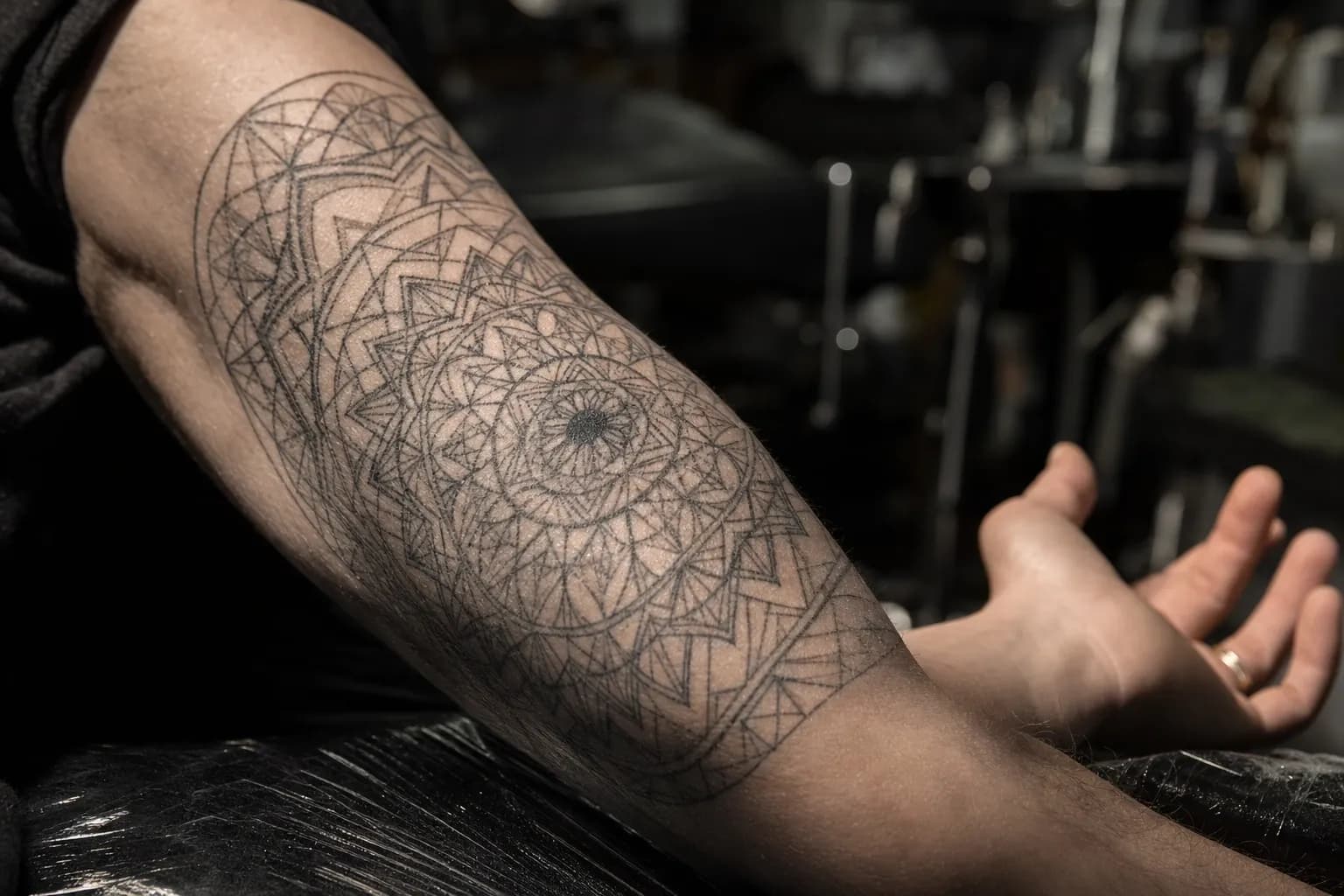
The word mandala comes from Sanskrit and means, simply, circle. In Hindu and Buddhist practice, mandalas are used as meditation aids representing the structure of the cosmos. Every ring, petal and geometric layer is placed with intention. As a tattoo, a mandala most often signals a search for balance or a meditative approach to life.
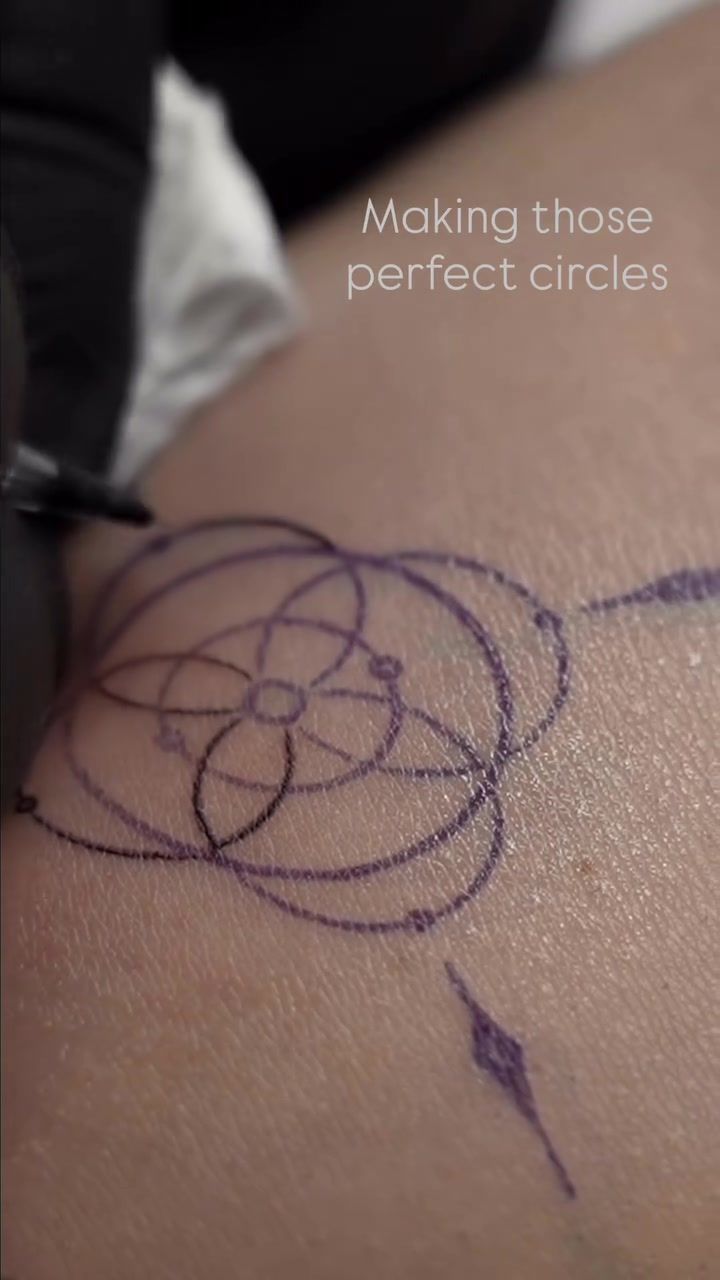
They are also among the most technically demanding geometric patterns to execute. If the radial symmetry is off by even a millimetre at the stencil stage, you'll see it every single time you look at the finished piece. Precision isn't optional here.
Sacred Geometry: The Patterns That Go Deeper
Decorative geometric and sacred geometry are not the same thing, and the distinction matters beyond marketing. Decorative geometric uses mathematical forms for their visual impact. Sacred geometry holds that specific patterns encode fundamental truths about the universe, because those patterns appear across nature, architecture and the cosmos at every scale.
Flower of Life
The Flower of Life is a lattice of overlapping circles arranged in a hexagonal grid. It has been found carved into the Temple of Osiris at Abydos, in the ruins of Assyrian palaces, and in ancient Chinese and Indian manuscripts. The symbol suggests that all living things arise from the same geometric template. As a sacred geometry tattoo, it carries a meaning of interconnectedness: everything relates to everything else.
Metatron's Cube
Metatron's Cube is constructed by drawing lines connecting the centres of thirteen circles arranged in the Fruit of Life pattern. The result contains all five Platonic Solids hidden within it. It's associated with divine order and protection across several mystical traditions. Visually, it's complex enough to reward close inspection long after the tattoo heals.
Platonic Solids
The five Platonic Solids are the only perfectly regular three-dimensional forms: the tetrahedron, cube, octahedron, dodecahedron, and icosahedron. Classical philosophy assigned each to one of the elements: fire, earth, air, ether, and water respectively. Tattooed as geometric shapes tattoo designs, they're often chosen by people who feel a strong connection to one specific element or to the idea of elemental balance across all five.
The Seed of Life and Vesica Piscis
The Vesica Piscis is formed where two circles of equal size overlap so that each circle's centre lies on the other's circumference. The overlapping zone creates an almond shape that appears in early Christian art, Pythagorean mathematics, and medieval architecture. It speaks to duality and union: two distinct things creating something new in their meeting. The Seed of Life builds outward from this same geometry using seven overlapping circles.
How the Studio Approaches Geometric Meaning in Lisbon
The consultation isn't a menu selection. The artist asks what draws you to a specific form, not to assign meaning for you, but to understand whether you're arriving with deep research or a gut pull toward a shape. Both are honest starting points. Neither is more valid than the other.
"Some clients spend months researching sacred geometry before they arrive. Others simply know they need a circle and can't explain why. The conversation is always worth having, because your reason for choosing a shape changes how we design the piece."
Lisbon's azulejo tradition comes up regularly in geometric consultations. The interlocking star patterns and radial tile designs that cover the walls of churches in Mouraria and staircases across Lapa are a genuine visual reference for the studio's geometric work, not a tourism talking point. Clients who have lived here often arrive with a sensitivity to that pattern language already built in.
Precision is where craft meets meaning. A mandala tattoo meaning is undermined if the execution is sloppy. If the stencil sits 2mm off-centre on a radially symmetric piece, you'll see it every time. The studio's approach to the geometric tattoo service prioritises stencil accuracy and line discipline above all else: the geometry has to be right before the needle touches skin.
To understand what that precision actually demands at the design stage, read about what it really takes to get geometric design right.
Combining Symbols: When Geometry Meets Other Imagery
Some of the most layered work comes from combining geometric framing with figurative subjects. The geometry doesn't just decorate; it contextualises. It changes what the figure means.
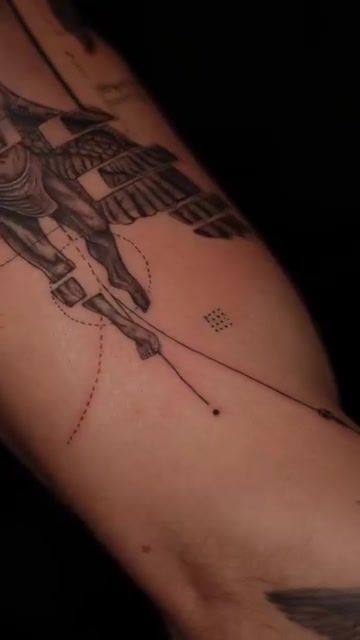
Consider Icarus in Geometric Architecture: the myth of a young man who flew too close to the sun, contained within a precise mathematical framework. The hubris of the story sits in tension with the cold rationality of the geometric structure around it. That tension is the point. It produces something neither element could achieve alone.
The same logic applies to geometric circles used to frame pet portraits. The unbroken circle around a beloved animal isn't decoration; it's a statement about continuity and an unending bond. The geometric form amplifies what the figurative subject is already saying.
Geometric linework and fineline technique share the same needle discipline and line-weight control. They migrate naturally into each other. A mandala built with the same needle used for a delicate botanical portrait maintains visual consistency across a larger piece. Placement still shapes the reading, though. A triangle on the spine reads as something structural and load-bearing. The same triangle on a wrist reads as lighter, more personal. As a general rule, how placement shapes the meaning of any tattoo is worth thinking through before you finalise a design.
Practical Considerations Before You Book
Geometric tattoo Lisbon clients often ask about size and placement together. The two questions are genuinely linked. A Flower of Life at 6cm diameter across the sternum needs a different session budget from a 3cm version on the inner wrist. Here's a general guide.
| Pattern type | Recommended placement | Minimum workable size | Typical session length |
|---|---|---|---|
| Single circle or line geometry | Wrist, collarbone, ankle | 3 cm | 1 hour or under |
| Mandala (moderate complexity) | Upper arm, thigh, chest | 8 cm diameter | 3-4 hours |
| Mandala (high complexity) | Back, thigh, full sleeve | 12 cm diameter | 5-6 hours, possibly two sessions |
| Sacred geometry (Flower of Life, Metatron's Cube) | Sternum, back, upper arm | 7 cm | 3-5 hours |
| Geometric with figurative element | Forearm, thigh, back | 10 cm | 4-6 hours |
Healing a geometric piece in Lisbon has a seasonal dimension. In July and August, the city's humidity and heat make sweat management on a fresh tattoo genuinely important. Avoid the beach, any pool, and direct sun for at least three weeks after your session. The peeling phase runs slightly longer in humid conditions. December through February, with Lisbon's mild and drier winters, is an easier window for healing tight geometric linework without the skin drying and cracking the way it might in a harsher northern climate.
Skin tone affects how geometric patterns read. High-contrast black linework on lighter skin gives a very different visual snap from the same design on a deeper tone. Neither is better, but the design may need to account for line weight and spacing differently. This is exactly what the consultation is for.
For a broader look at how healing unfolds week by week after any tattoo, the studio's guide to the tattoo healing process covers what to expect at each stage.
- Bring reference images of shapes or patterns you're drawn to, even if you can't articulate why.
- Note any cultural or personal context behind your chosen symbol: it informs the design conversation.
- Wear or bring clothing that gives easy access to your intended placement.
- Eat a full meal before a session lasting more than two hours.
- Arrive with clean, moisturised (but not freshly lotioned) skin at the placement site.
And for anyone considering a smaller geometric piece specifically, the article on tattoo placement ideas for small tattoos covers which spots hold fine detail over time and which tend to blur.
- Decide on the symbol or shape first, before thinking about size.
- Research placement: how the piece sits on the body affects how the geometry reads.
- Book a consultation to discuss the design in detail before committing to a session date.
- Follow aftercare instructions precisely; geometric linework is unforgiving of a patchy heal.
Frequently Asked Questions
What does a geometric tattoo mean?
Geometric tattoos draw on thousands of years of shared human symbolism. Circles suggest wholeness and continuity; triangles represent direction and elemental forces; spirals evoke growth and the natural order. The meaning is also personal. Many clients choose geometric forms because they feel universally resonant rather than tied to one specific cultural tradition.
What is the most meaningful geometric shape for a tattoo?
There's no single answer, but the circle and the mandala carry the broadest cross-cultural weight. Both appear in Buddhist, Hindu, Celtic and Islamic traditions as symbols of completeness and cosmic order. The Flower of Life is another strong contender, found carved in ancient temples across multiple civilisations, suggesting interconnectedness of all life.
Do geometric tattoos have to have a specific meaning?
No. Some clients arrive with precise symbolic intent; others are drawn to a shape purely through visual instinct. Both are honest starting points. A well-executed geometric piece carries its own visual integrity regardless of assigned meaning, and meaning can deepen over time as the piece becomes part of your life.
What does a mandala tattoo mean?
Mandala comes from Sanskrit and means circle. In Hindu and Buddhist practice, mandalas represent the cosmos and are used as meditation aids. As a tattoo, they're commonly chosen to express a desire for balance, inner focus or spiritual grounding. The radial symmetry makes them technically demanding; precision in the stencil is critical to the finished result.
How long does a geometric tattoo take to heal in Lisbon's climate?
Surface healing takes roughly two to three weeks. Full dermal settling takes closer to eight weeks. Lisbon's humid summers slow the peeling phase slightly and make sweat management important: avoid direct sun and saltwater on a fresh piece. Mild winters are generally easier for healing tight geometric linework without excessive skin drying.
Can geometric patterns be combined with portrait or figurative tattoos?
Yes, and the combination often produces some of the most layered work. Geometric framing or sacred geometry backgrounds can contextualise figurative subjects: a mythological figure within a precise architectural grid, for example, creates a dialogue between the human and the mathematical. Placement and scale planning are especially important in these hybrid pieces.