Why Geometry on Skin Is Not Like Geometry on Paper
Paper stays flat. Skin doesn't. That gap between the two is where most geometric tattoo design goes wrong, and it's the first thing any serious artist has to solve before the machine ever touches you.
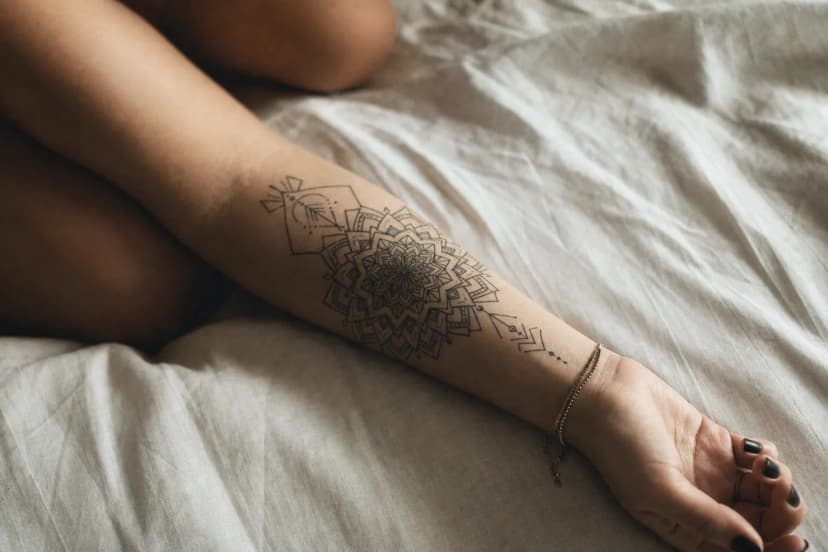
Consider a mandala centred on the forearm. The stencil sits on a curved, asymmetric surface that shifts when the wrist rotates. If it lands 2mm off-centre, every radial line in the finished piece will confirm that error. You'll see it in every photograph. You'll see it every time you glance at your arm. Geometric work punishes inaccuracy more than almost any other style, precisely because the eye expects perfection from mathematical forms.
Lisbon offers a local shorthand for understanding this impulse. The city's azulejo tile tradition, those hand-painted ceramic panels covering church facades from Alfama to Príncipe Real, has been solving the same problem for centuries: how do you render a repeating geometric pattern across an irregular surface and make it look inevitable? The answer, then and now, is preparation. The studio draws on that same patient drafting logic when approaching a geometric piece.
What Geometric Tattoo Design Actually Covers
"Geometric" is a broad category. It contains several quite different aesthetics, and knowing which one you're drawn to makes the consultation far more productive.
Sacred geometry and mandalas
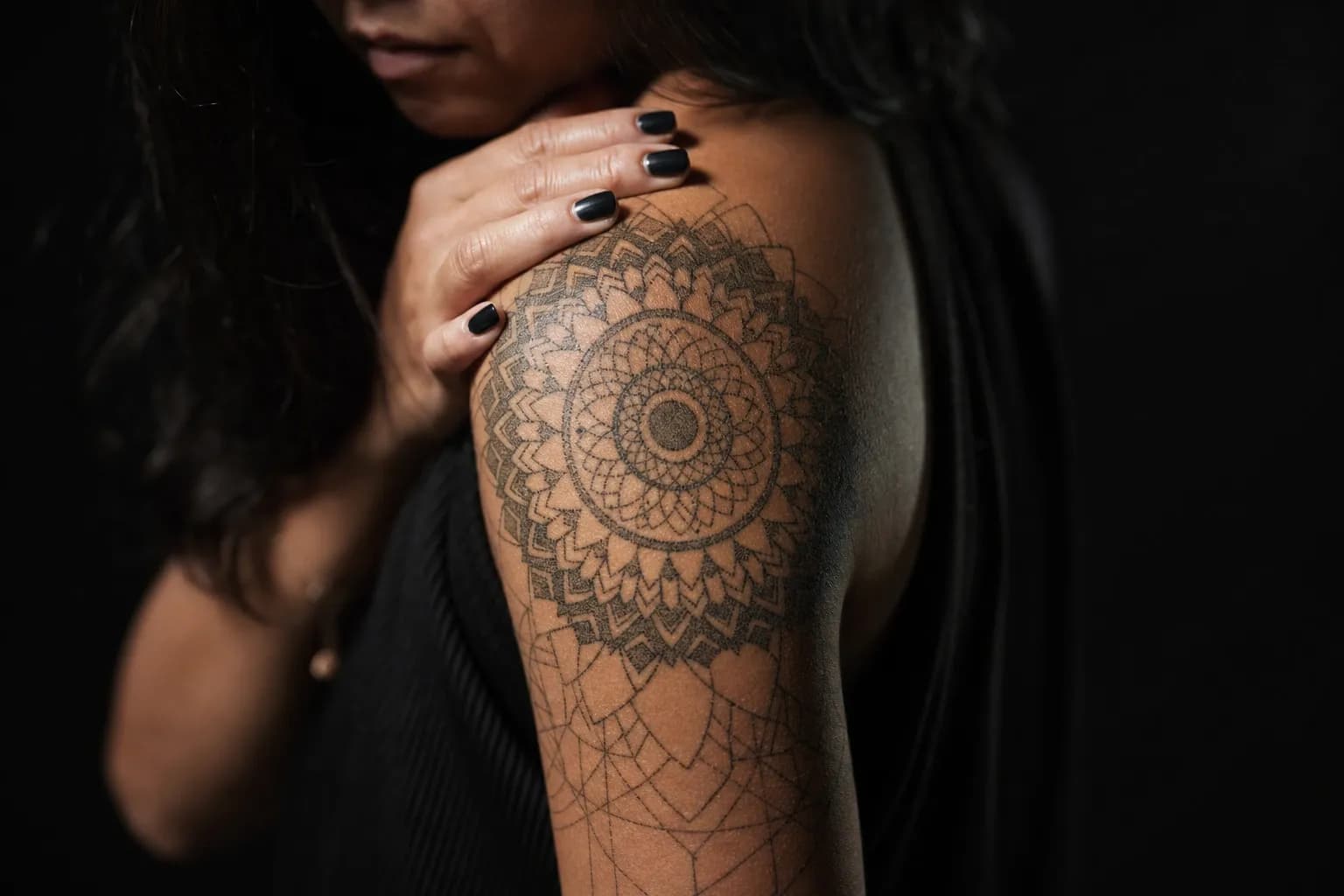
Sacred geometry refers to patterns built from mathematical ratios found repeatedly in nature: the spiral of a nautilus shell, the hexagonal packing of a honeycomb, the proportions of a sunflower's seed head. Designs like the Flower of Life (overlapping circles forming a repeating hexagonal grid) or Metatron's Cube (all five Platonic solids mapped within a single figure) belong to this category. They carry symbolic weight for many clients, but they work visually even without the symbolism, because the underlying mathematics gives them an inherent harmony.
A mandala tattoo design is built on radial symmetry, meaning the pattern repeats outward from a central point, like slices of a pie. The number of segments matters practically: an eight-segment mandala requires eight identical repetitions of a motif, so any irregularity in one slice will show up against seven perfect comparisons. A 15cm mandala with dotwork fill (tiny stippled dots used to create tonal shading) realistically needs three to four hours of work, often split across two sessions for client comfort.
Architectural and structural geometry
These designs borrow from engineering: cubes rendered in forced perspective, geodesic spheres, Platonic solids (the tetrahedron, octahedron, and their kin). They tend toward bold linework and strong negative space (the bare skin left untattooed, which carries as much visual weight as the ink). They age well because the lines are structural rather than decorative.
Geometric fineline and minimalist forms
This is where the geometric tattoo service meets fineline technique. Thin, precise strokes. Sparse compositions. A single perfect triangle or a set of concentric circles that uses the skin's natural tone as part of the design. You can read more about how fineline technique applies to geometric designs and why the overlap between these two styles demands particular needle discipline.
What the studio doesn't do in this space: no tribal geometry, no biomechanical patterning. The focus stays on work where precision and intentional composition drive the outcome.
The Craft Behind the Lines
Stencil accuracy
The stencil isn't decoration. It's the structural blueprint, and it dictates everything that follows. Before any ink goes in, the artist checks the stencil placement from multiple angles and in multiple mirrors. For radial designs, the centre point is confirmed first. For linear designs, a spirit level app on a phone is not overkill. If the stencil is wrong, no amount of skill during the tattooing phase will save the piece.
Needle choice and line weight
A single needle, the finest option available, produces hairline strokes used in delicate geometric fineline work. These lines are elegant and subtle, but they require confident, even machine speed; any hesitation shows as a thicker deposit of ink mid-stroke. For slightly heavier structural lines in a precision geometric tattoo, a round liner (a tight cluster of three to five needles) gives a more consistent line with less risk of variation from hand pressure. The artist selects needle configuration based on the design before the session begins, not during it.
Symmetry on a moving canvas
The forearm is relatively forgiving. The sternum less so. The ribcage is the hardest: every breath shifts the surface slightly, so linework there requires the client to hold still during each stroke, and the artist to work in short passes. A mandala placed on the sternum needs to be mapped against the natural vertical axis of the body, not just the axis of the stencil on flat skin. These aren't problems; they're variables the artist accounts for in session planning.
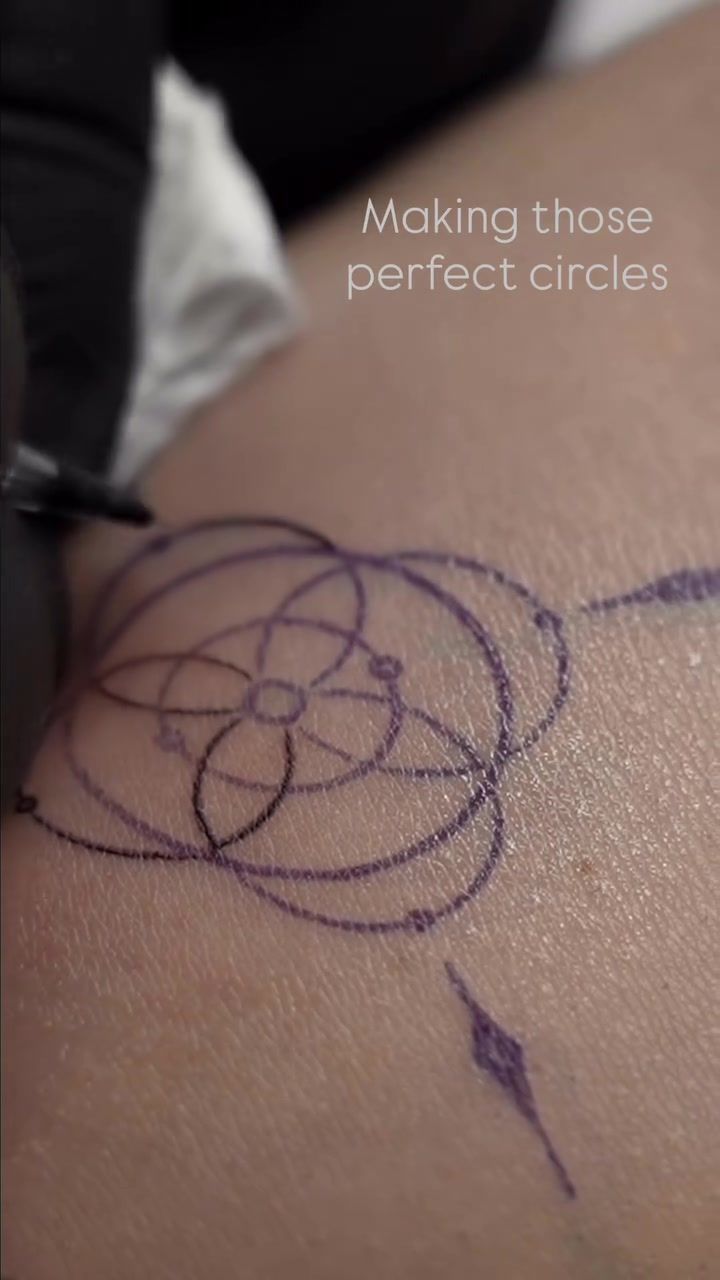
Ink saturation is another variable. Thin geometric lines don't need heavy ink passes. Overworking a single-needle line blows it out (spreads the ink into surrounding skin), permanently widening the stroke. You get one clean pass, maybe two. That demands a settled, unhurried hand, and a client who understands that speed in geometric tattooing is not a virtue.
How the Studio Approaches Geometric Design
The consultation and design phase
Every piece starts from scratch. The studio doesn't work from flash sheets (pre-drawn designs sold to multiple clients). Reference images you bring are a starting point for a conversation, not a copy order. The artist is looking for what you respond to: the line weight, the density of detail, the balance of filled areas versus negative space.
After the consultation, design typically takes one to two weeks depending on complexity. Ratio checks happen during this phase, confirming that the design scales correctly to your chosen placement. A composition that works at 20cm may fall apart at 10cm, or require different internal detail to read clearly at the smaller size. This is what precision means in geometric work: decisions made before the session that protect the piece for decades.
Incorporating personal meaning without losing geometric clarity
Some clients want a sacred geometry tattoo that carries a specific significance. Others want pure form. Either is valid. Where it gets interesting is combination work: a realistic figure set within a geometric frame, or botanical elements radiating outward from a mandala core.
"The geometry has to be the skeleton, not the decoration. If the geometric structure is strong enough to stand alone, adding a figurative element only makes it richer. If the structure is weak, nothing you place inside it will save it."
The Icarus in Geometric Architecture piece demonstrates exactly this: a mythological figure rendered with micro-realist detail, suspended within a precise geometric framework, and the two elements hold each other in tension without either one overwhelming the composition.
Placement, Sizing, and What to Expect in the Session
Placement affects everything: symmetry, healing, longevity, and session length. The table below gives an honest breakdown of how different body locations behave for geometric work.
| Placement | Canvas behaviour | Typical session length | Longevity notes |
|---|---|---|---|
| Outer forearm | Relatively flat, low movement | 90 min. 3 hours | Excellent; minimal sun exposure possible with sleeves |
| Sternum / chest | Curved, requires careful axis mapping | 2. 4 hours | Good; protected from UV most of the year |
| Upper back / spine | Large flat canvas, ideal for vertical symmetry | 3. 5+ hours (often split) | Very good; minimal friction from clothing |
| Ribcage | High movement (breathing), sensitive skin | 2. 4 hours with more breaks | Good if healed carefully; more challenging session |
| Hand / fingers | High friction, fast cell turnover | 45 min. 2 hours | Fades faster; touch-ups more likely |
For a geometric piece with fine internal detail, 6 to 8 centimetres across is a practical minimum if you want the lines to remain distinct as the skin matures. Smaller is possible, but only for very simple forms with minimal internal structure.
- Wear comfortable, loose clothing that gives easy access to the placement area
- Eat a proper meal two hours before your session; blood sugar stability matters during long work
- Avoid alcohol for 24 hours beforehand. It thins the blood and affects ink uptake
- Moisturise the area daily for the week leading up to your appointment; hydrated skin takes ink more evenly
- If you're coming from outside central Lisbon, the studio is accessible by metro; check the studio's contact page for the nearest stop
Healing a Geometric Tattoo in Lisbon
Thin geometric lines are more vulnerable to sun damage than the bold, heavily saturated lines of traditional work. In Lisbon's summers, UV intensity along the Tagus waterfront is high from May through September. A freshly healed geometric tattoo exposed to that level of sun without protection will oxidise faster, the fine lines shifting from sharp black toward a softer, cooler grey years ahead of schedule.
For the first four weeks, avoid soaking the tattoo entirely. No ocean swims off Cascais. No Tejo river dips. No long baths. The open wound phase closes within two weeks for most people, but the deeper layers of the dermis (the skin layer where ink permanently lives) continue healing for six to eight weeks. A shower is fine. A swim is not.
- Days 1-3: keep the piece covered with a breathable film dressing; change it if fluid pools beneath
- Days 4-14: wash gently twice daily with fragrance-free soap; pat dry; apply a thin layer of unscented moisturiser
- Weeks 3-4: the surface will peel and may look slightly dull. This is normal; don't pick at it
- Week 12: the artist can assess whether a touch-up is needed; geometric lines, especially single-needle work, thin slightly as the skin heals, and a touch-up at this point is a routine part of the process, not a sign of poor work
- Once fully healed: use SPF 50 on any exposed geometric work, every time it will be in direct sun
Lisbon's mild winters are actually good news for winter-booked appointments. Lower UV, lighter clothing over the healing area, and cooler temperatures that reduce perspiration all help with the early healing phase. If your schedule allows, November through February is a sensible window for larger geometric pieces.
For a broader look at how small and detailed work heals specifically, the guide on small healing tattoo ideas covers the considerations that apply directly to geometric pieces with fine internal detail.
Frequently Asked Questions
How long does a geometric tattoo design take to plan and execute?
Design planning typically takes one to two weeks after your consultation, depending on complexity. Execution varies significantly: a small geometric symbol might take 90 minutes, while a detailed mandala or multi-element forearm piece can run four hours or more. The artist will give you a session estimate after reviewing your design brief.
What size should a geometric tattoo be for it to age well?
For geometric work with fine internal detail. Concentric rings, dotwork fill, or radiating lines. A minimum of 6 to 8 centimetres across gives the lines room to breathe over time. Smaller than that, fine details can merge as the skin matures. Placement on lower-movement areas also helps longevity considerably.
Can geometric designs be combined with other styles like realism or floral?
Yes, and some of the most striking pieces do exactly that. A realistic figure emerging from a geometric frame, or botanical elements growing outward from a mandala, can work beautifully when the two styles share a tonal language. It requires careful planning so neither element visually dominates or undermines the other.
Does a geometric tattoo hurt more than other styles?
Pain depends almost entirely on placement, not style. A geometric piece on the inner wrist or sternum will be more uncomfortable than one on the outer forearm, regardless of the design. Long geometric sessions with repeated passes over the same area can cause cumulative sensitivity, so breaks are normal and encouraged.
How do I prepare a reference for a geometric tattoo consultation in Lisbon?
Gather three to five images that show elements you're drawn to, not necessarily one finished tattoo you want copied. Note what you like specifically: the line weight, the symmetry style, the level of negative space. Size references help too. The more specific you are, the more useful the consultation becomes for both you and the artist.