Why a Sleeve Is the Most Demanding Geometric Project You Can Commission
A sleeve is not a collection of separate tattoos placed side by side. Every element has to relate to every other. In proportion, in tone, in visual weight. Get that wrong and the arm looks busy rather than composed.
Geometric styles expose structural inconsistencies more than almost any other style. A line that runs 2 degrees off-parallel across a mandala section is invisible in a loose floral arrangement. In a geometric sleeve tattoo, you'll see it every time you look down at your arm.
The arm itself adds another layer of complexity. It's a three-dimensional cylinder, not a flat page. Designs sketched on paper distort as they wrap around the limb. The outer forearm, the inner wrist, the shoulder cap. Each surface behaves differently. Understanding that from the outset changes how you plan everything that follows.
The Two Main Approaches: Planned from Day One vs Built Over Time
The fully planned sleeve
A fully planned sleeve maps the entire arm before needle touches skin. Every anchor point, every connecting element, every zone of negative space is decided in advance. It's the cleaner approach. The design logic holds because nothing is added reactively.
It also requires a larger upfront commitment: multiple consultations, detailed reference gathering, and trust that the vision you have today is one you'll want to live with for decades. For most people commissioning a geometric sleeve tattoo design from scratch, this is the right path.
The patchwork-to-sleeve approach
Some clients arrive with two or three existing pieces on their arm and want them connected into something cohesive. That's a different problem. The existing work has to be assessed for style compatibility. New elements need to frame and bridge without visually fighting what's already there.
Geometric work is more forgiving for patchwork than realism. A mandala can anchor almost anywhere, and linework can flow around an existing piece without requiring colour-matching. But it's less forgiving than floral, where organic shapes can bend and adapt. The studio's first job in a patchwork consultation is to establish a unifying visual language: a consistent line weight, a consistent spacing rhythm, a consistent relationship between black and skin.
What a Geometric Sleeve Is Actually Made Of
Structural anchors
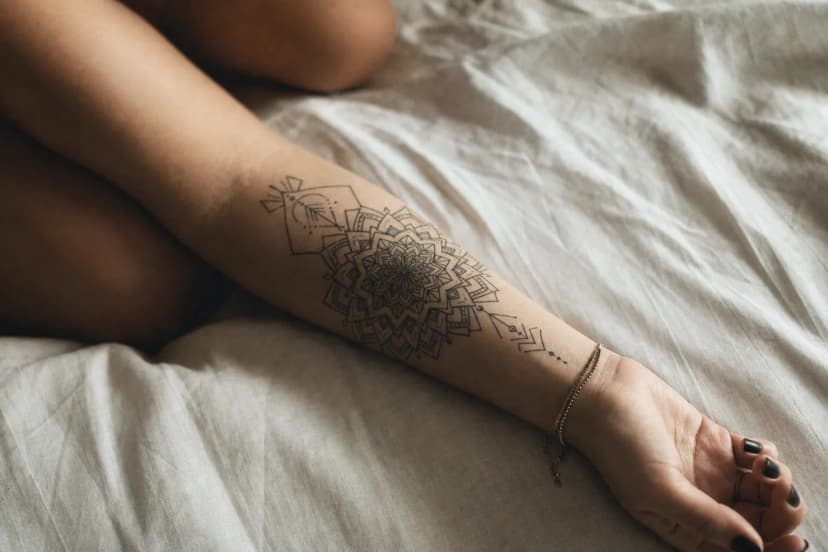
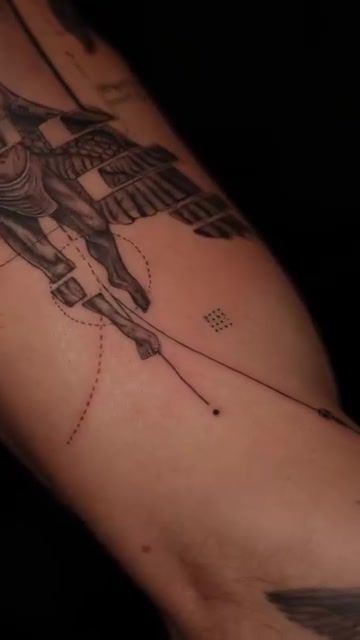
Every sleeve needs focal points. In geometric work, these are typically mandalas, Metatron's cube (a sacred geometry figure built from overlapping circles and straight lines connecting their centres), compass roses, or portrait medallions framed in geometric borders. These anchors occupy a specific zone. Upper arm, forearm centre, wrist. And everything else radiates from them.
Flow elements
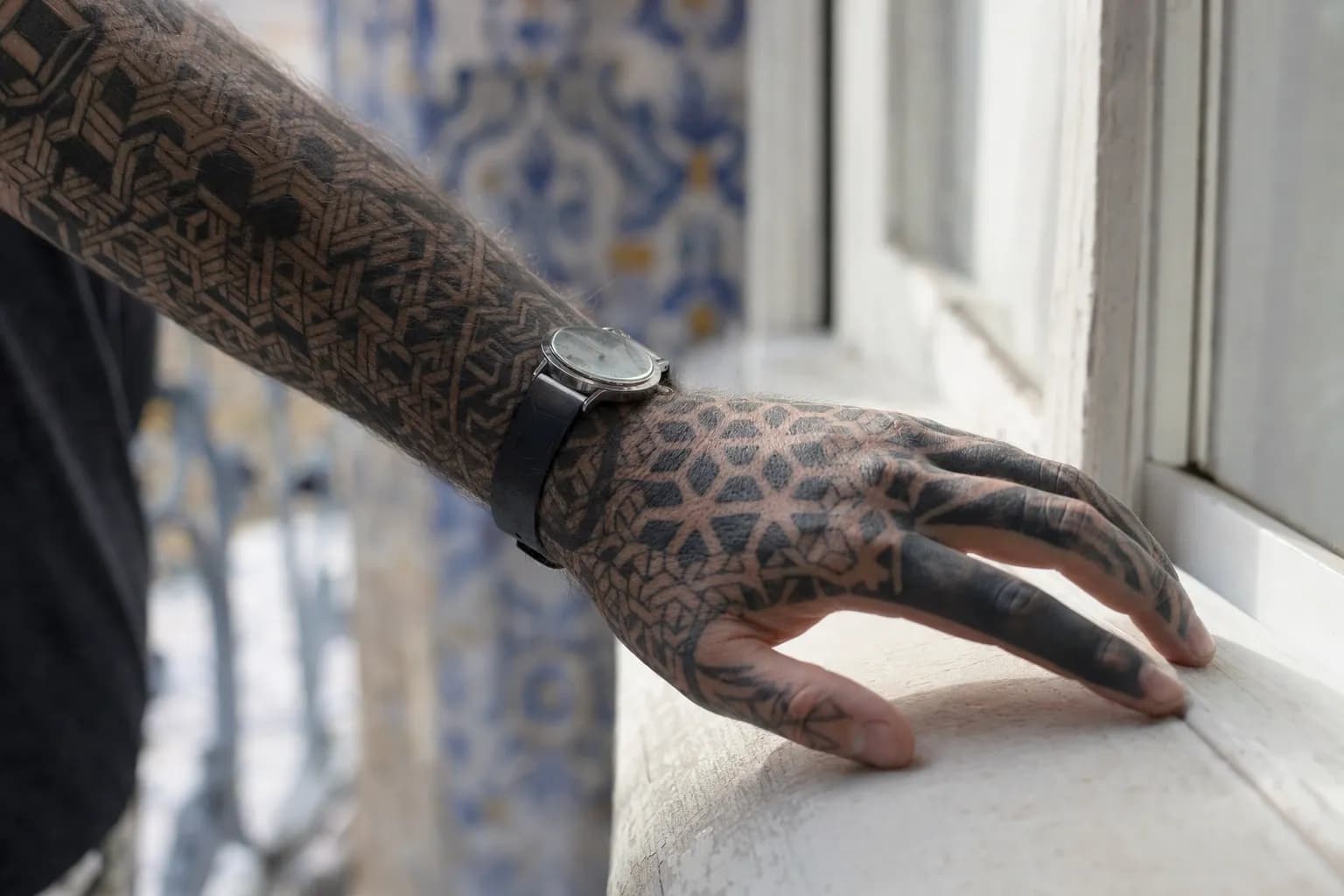
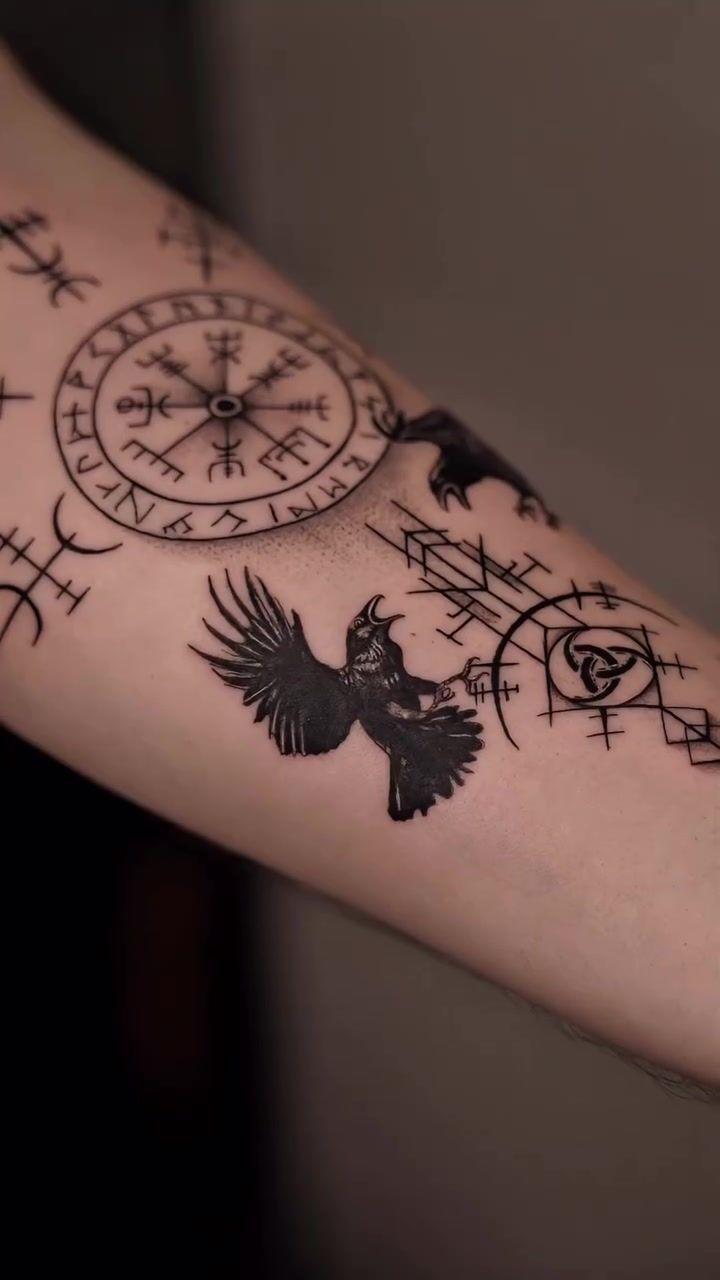
Flow elements are the connective tissue. Linework, dot-work (tiny ink dots arranged to create shading or texture), Fibonacci curves (spirals that follow the mathematical golden ratio), and repeating tessellations (interlocking shapes that tile without gaps) bridge the anchors and guide the eye around the arm. Without them, a sleeve reads as separate pieces rather than one piece.
Negative space
Unpainted skin is a design decision, not an oversight. In a geometric sleeve tattoo, negative space gives the eye somewhere to rest. It also determines legibility. In ten years, as the skin ages, it's the negative space that keeps a dense piece readable.
Lisbon has its own geometric vocabulary worth mentioning here. The azulejo tile patterns covering façades in Alfama and Príncipe Real. Interlocking blues and whites in radial and grid formations. Carry the same logic as sacred geometry arm tattoos: a repeating module that creates complexity through precision. That influence surfaces naturally in certain client briefs, and the studio embraces it when it does.
Session Structure: How Many Sittings Does a Sleeve Actually Take?
The honest answer depends on design density, your skin's response, and how regularly you can book. But here's a working framework based on sleeve scope.
| Sleeve Scope | Approximate Sessions | Total Chair Time |
|---|---|---|
| Quarter sleeve (elbow to wrist or shoulder to elbow) | 2-4 sessions | 4-10 hours |
| Geometric half sleeve tattoo | 4-7 sessions | 10-20 hours |
| Full sleeve geometric tattoo | 8-14 sessions | 20-40 hours |
These are estimates, not guarantees. A full sleeve geometric tattoo with fine linework and dense dot-work shading will sit at the higher end. A cleaner, more open mandala sleeve tattoo with generous negative space will sit closer to the lower end.
Between sessions on overlapping areas, a minimum of four to six weeks is needed. The skin has to complete its surface healing before it's worked again. Pushing that window risks traumatising tissue that hasn't fully settled, which shows up as inconsistent line quality.
One practical note for anyone booking in summer: Lisbon's August humidity slows surface healing compared to the city's mild winters. The skin stays slightly more moist, which can extend peeling and the final settling of ink. Factor an extra week into your timeline if you're booking heavily during August and September.
How the Studio Designs a Geometric Sleeve
The process starts with the arm itself, not a drawing. The studio maps the limb in zones during consultation. Shoulder cap, upper arm outer and inner, elbow zone, forearm outer and inner, wrist. Before any design work begins. Each zone has different curvature, different skin behaviour, and different visibility in daily life.
Pencil on paper comes before digital tools. Rough compositional sketches show how the anchors distribute across the arm's length. Only once the zone logic is agreed does the work move to detailed design.
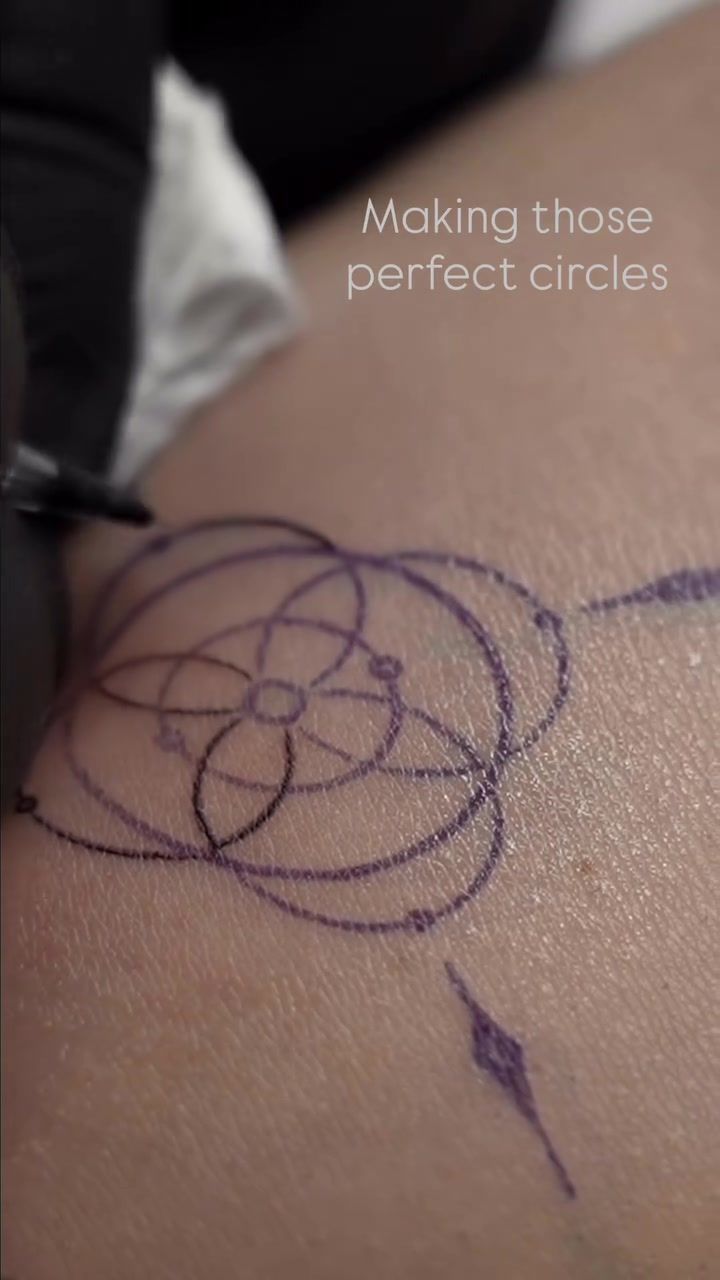
Stencil accuracy is where the real technical precision happens. A stencil is a transfer of the design onto the skin before the needle starts. And on a rounded limb, a flat stencil distorts. The artist accounts for the arm's circumference when scaling radial designs like mandalas. If the stencil sits 2mm off-centre, the finished piece reads as asymmetrical. You'll see it every single time you look at your arm. That margin is why the placement stage of each session takes as long as it does.
For a deeper look at the technical demands of this style, the guide on what geometric tattoo design actually requires covers the craft principles in detail. And if you're ready to start a conversation about your own sleeve, the studio's geometric tattoo service page outlines what the consultation process involves.
"Every session on a sleeve should feel like you're returning to a piece of architecture rather than starting something new. The structure has to be there from the first line. You can't retrofit coherence."
Placement Realities: Where the Hard Parts Are
Not every part of the arm holds geometric linework equally well. The ditch. The inner elbow crease. Flexes constantly. Linework here blurs faster than anywhere else on the sleeve. The studio applies ink slightly heavier in this zone to compensate for the early fading that comes with constant movement.
The wrist fold presents the same challenge. Skin there is thin and moves with every grip and rotation. Geometric elements placed across the wrist need to account for that mobility in the design itself. Simpler geometry, slightly bolder lines.
The outer forearm is the most stable surface on the sleeve. Lines placed here hold their sharpness longest. It's the natural home for the most intricate geometric work: tight tessellations, precise dot-work grids, fine measurement-dependent patterns.
The shoulder cap is a different problem. Radial designs. Mandalas, compass roses, anything with rotational symmetry. Distort on the deltoid unless the artist maps the muscle's curvature into the stencil. A circle drawn flat will read as an oval once it wraps over the shoulder's rounded peak. The artist accounts for that in the design stage, not after the stencil is already on the skin.
Skin tone matters too. On deeper skin tones, negative space needs to be wider to remain legible over time. Finer gaps between linework can close as the skin matures. The studio adjusts spacing at the design stage based on a proper assessment of your skin in person. Not from a photo. For a broader look at how placement affects a tattoo's long-term appearance, the article on how placement affects tattoo longevity is worth reading before your consultation.
Aftercare Across a Multi-Session Sleeve
Each session heals independently. A fresh section tattooed on the forearm needs the same care as if it were a standalone piece. Regardless of what's happening with the older, healed sections around it.
- Keep the freshly tattooed area clean and lightly moisturised for the first two weeks.
- Avoid submerging the arm. No swimming pools, no Atlantic coast waves. For three to four weeks after each session. Prolonged water exposure draws ink from skin that's still healing at the surface level.
- In Lisbon's summer months, apply SPF 50 to any healed sections exposed to direct sun. UV breaks down ink faster on healed geometric linework than on most other styles, because the style relies so heavily on the contrast between precise black lines and clean skin.
- When moisturising, you'll often be managing two states simultaneously: unhealed skin from the most recent session and fully healed skin from earlier sessions. Use an unscented, lightweight moisturiser on both. Don't over-apply to the fresh area.
The discipline required across a multi-session sleeve is real. People underestimate it. A full sleeve geometric tattoo built over 18 months means 18 months of paying attention to that arm: booking consciously, healing properly between sessions, protecting the finished sections while the new ones settle.
- Book sessions with at least four to six weeks between overlapping areas.
- Keep your confirmation of each session's zone so you and the artist track what's healed and what isn't.
- Tell the artist if anything healed unexpectedly. A patchy section, a line that blurred. Before the next session begins. Touch-up decisions are easier to make early than late in the sleeve's build.
Frequently Asked Questions
How long does a full geometric sleeve take to complete?
A full geometric sleeve typically requires 8 to 14 sessions, each lasting 2 to 4 hours, spread across 12 to 24 months. The timeline depends on design density, how quickly your skin heals between sessions, and how regularly you can book. Working over unhealed skin affects line quality, so spacing sessions correctly matters as much as the total number of sittings.
Can I start a geometric sleeve if I already have existing tattoos on my arm?
Yes, but it requires careful planning. Existing pieces need to be assessed for style compatibility and incorporated into the layout. Geometric work can bridge and frame existing tattoos effectively. A mandala can anchor near almost any pre-existing piece. The design process is more complex than building from a blank arm, and the consultation needs to address that honestly from the start.
How do I know if a geometric sleeve will suit my arm shape and skin tone?
A thorough consultation is the only real answer. Arm circumference affects how radial designs like mandalas wrap around the limb. Skin tone influences how much negative space remains legible over time. The studio maps your arm in zones before committing to a layout, so these factors are addressed before any design is finalised. Not after the stencil is already on your skin.
Does a geometric sleeve hurt more than a standalone tattoo?
Pain varies by location on the arm rather than the sleeve format itself. The inner elbow and wrist fold are more sensitive than the outer forearm. Longer sessions naturally increase cumulative discomfort as the sitting progresses. Most people find the process manageable with good preparation: sufficient sleep the night before and a solid meal beforehand both make a real difference.
Should I choose a half sleeve or a full sleeve to start?
Starting with a geometric half sleeve tattoo is sensible if you're unsure about long-term commitment or have budget and time constraints. A well-planned half sleeve can extend to a full sleeve later, provided the original design anticipates that possibility. Raise that option in your first consultation so the layout leaves room for future expansion rather than closing off the composition at the elbow or shoulder.