Why 'Best' Is the Wrong Word to Search For
The phrase "best realism tattoo artist" gets typed into search bars thousands of times a day. It's understandable. You want someone exceptional. But 'best' is a dead end, because realism tattooing isn't primarily a matter of taste. It's a matter of measurable technical skill.
What you're actually asking is: does this person have the foundation to reproduce photographic depth, tonal gradients, and surface texture on skin? That question has a concrete answer. And you can find it by knowing what to look for.
This guide teaches you the criteria. Use them on any portfolio, from any city, and you'll stop guessing.
What Realism Tattooing Actually Is
Realism is the attempt to make a tattoo look like a photograph printed on skin. That sounds simple. The execution is anything but. The artist must control tonal gradients across a surface that moves, stretches, and heals unpredictably, using pigment that behaves differently in every layer of the dermis.
Black and Grey vs Colour Realism
Black and grey realism relies entirely on ink dilution and layering to create the illusion of light and shadow. No colour to lean on. Every tone comes from the ratio of ink to distilled water and the number of passes the needle makes. It's one of the hardest forms of tonal control in tattooing.
Colour realism adds pigment complexity: different colours fade at different rates, shift differently as skin ages, and require different needle groupings. The studio works in black and grey realism. Being honest about that scope matters, because a studio that claims to do everything well rarely does any of it exceptionally.
Fine Line Realism vs Traditional Realism
Traditional realism uses magnum needles (curved or flat clusters) to pack shading and build volume. Fine line realism merges single-needle precision with realistic shading. The lines are finer, the transitions more delicate, the margin for error smaller. You can read more about fine line realism and where it overlaps with fineline work in a separate guide, but the short version is this: it demands a steadier hand and more patience per square centimetre.
The Four Technical Markers of a Skilled Realism Artist
Skip the artist's follower count. Look at the work. Specifically, look for these four things.
Tonal Range
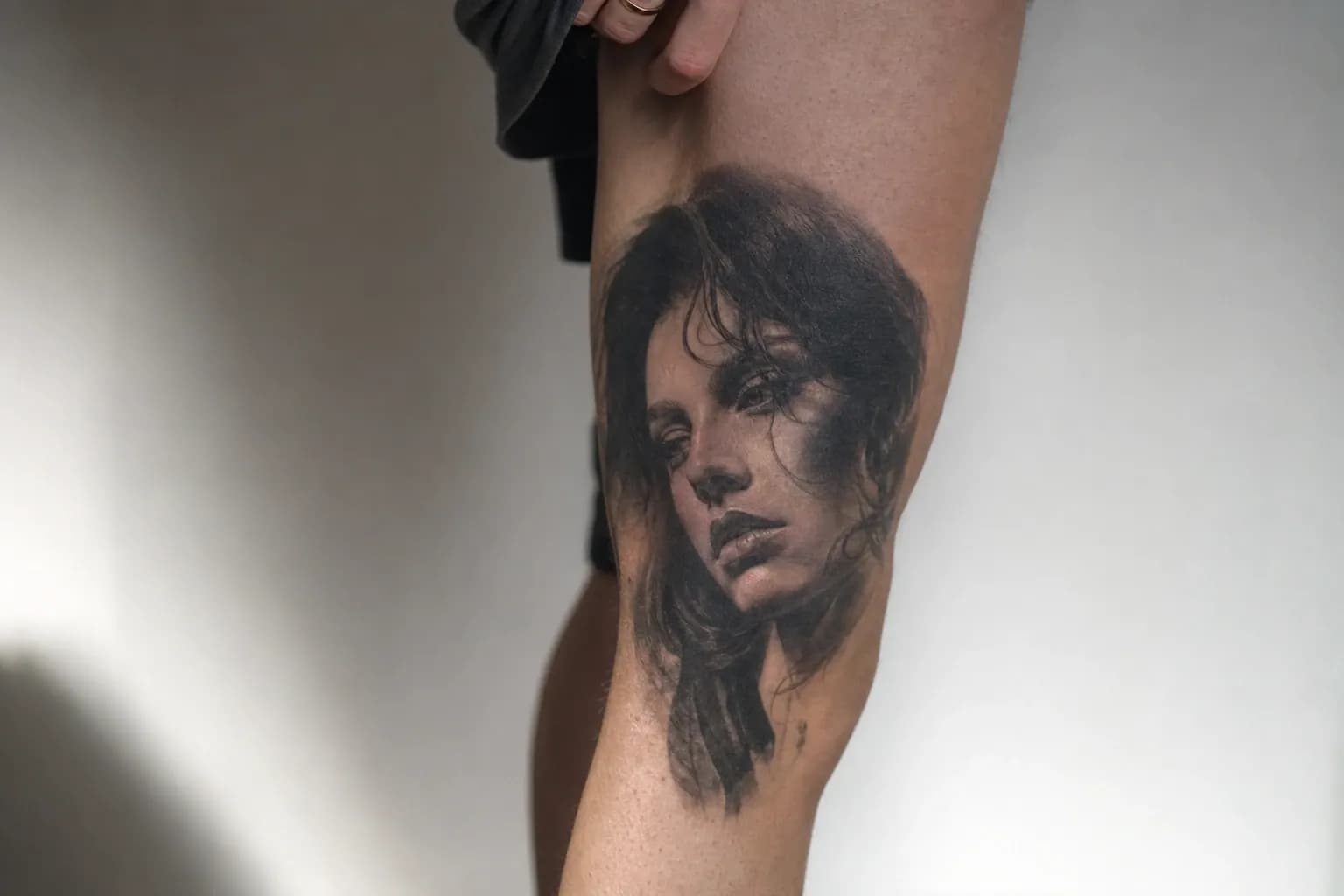
A strong black and grey realism piece shows true blacks and near-whites with smooth, seamless gradations between them. If every piece looks flat grey with no deep shadow, the artist isn't packing enough ink. If you see harsh transitions between light and dark with no mid-tones, the blending technique is weak.
Squint at the portfolio image. You should still read depth when you blur your eyes. If the image goes flat, the tonal range isn't there.
Skin Texture and Depth
Hair, stone, fur, and fabric each require a distinct technique. Hair needs directional strokes that follow the growth pattern. Stone needs rough, random variation. Fabric needs soft gradients with minimal hard edges. A skilled photorealistic tattoo artist shifts their approach for every surface they're rendering.
Look for that specificity. Generic shading applied the same way to every subject is the clearest sign of a technically limited portfolio.
Stencil Accuracy and Proportional Fidelity
If the stencil sits 2mm off-centre on a portrait, you'll see it every single time you look at the piece. Proportional fidelity. Getting the distance between a subject's eyes exactly right, the jaw width correct, the nose in precise relation to the lips. Is what separates a recognisable portrait from a vaguely humanoid shape.
This is especially critical for memorial pieces and commissioned portraits. The reference is the contract. A skilled artist honours it.
Healed Work (Not Just Fresh)
Fresh ink flatters everything. Colours look saturated. Lines look sharp. Contrast looks dramatic. The real test is six to eight weeks later, when the skin has settled and the true result emerges.
Ask specifically for healed photos. Any artist confident in their work will have them. If a portfolio only shows fresh pieces glowing under ring lights, treat that as a red flag worth noting.
What a Good Portfolio Actually Shows You
One outstanding portrait proves the artist had a good day with a cooperative subject. A portfolio proves consistency. Those are very different things.
Consistency Across Subjects
Look for variety: faces, animals, architectural elements, natural objects. Can the artist render fur with the same confidence they bring to human skin? Do portraits from six months apart show the same tonal control, or does the quality fluctuate? Consistency across subjects and across time is the real benchmark of a skilled realism artist.
One piece that's significantly better than the rest of the portfolio is worth noting. It might be an outlier in either direction.
Scale and Placement Variety
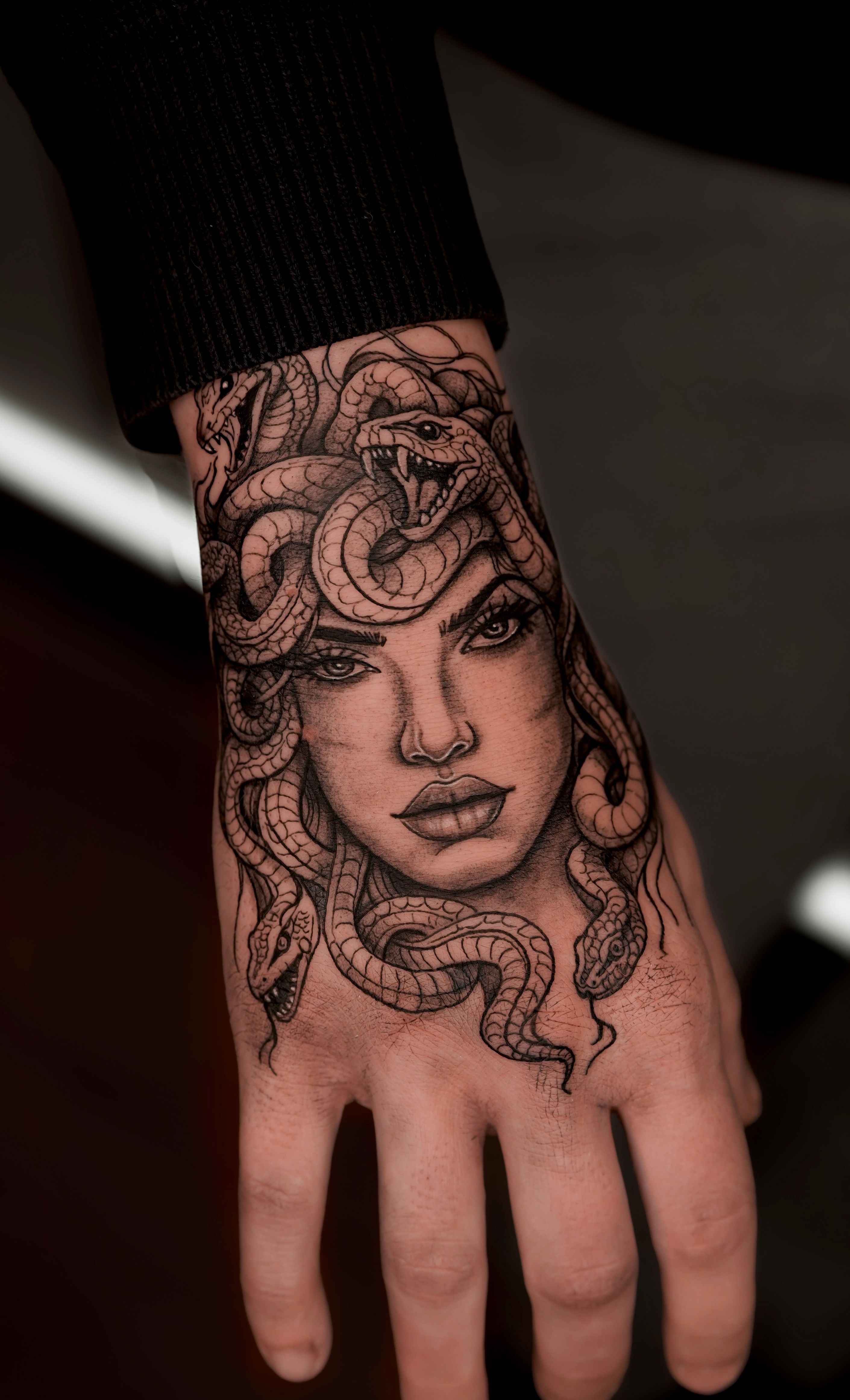
A thigh piece and a forearm piece are not the same challenge. Skin on the thigh is fleshier, more forgiving, and holds shading with less distortion over time. The hand shifts constantly and heals harder. The back offers the largest canvas but demands the most compositional planning.
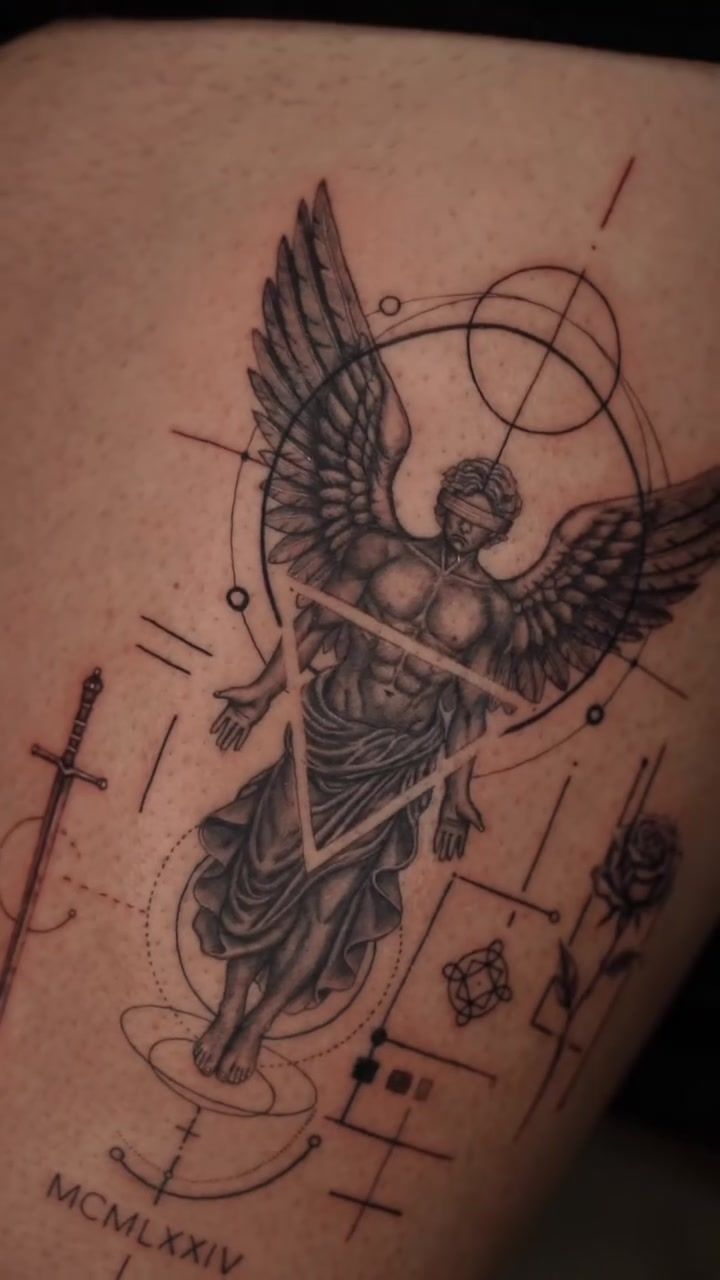
A strong portfolio shows work across different scales and placements. The Angel and Geometry Memorial Thigh Piece is a useful reference point here: the scale allows full tonal development, but the compositional decisions about where geometry meets portraiture require careful planning that a smaller piece simply doesn't demand.
You can explore the studio's full approach to photorealistic work on the realism tattoo service page, where you'll also find the consultation and booking process outlined clearly.
How the Studio Approaches Realism in Lisbon
Booking a realism piece at the studio is never a walk-in process. Complex work demands a proper conversation before a single line gets drawn.
The Consultation Process
Every realism piece starts with a detailed consultation. Placement, scale, reference images, and skin tone all get discussed before any design work begins. This isn't administrative formality. It's where the piece actually starts to take shape.
The studio's approach to realism in Lisbon is informed by years of working across different skin types, placement challenges, and reference materials. You can read a detailed breakdown of what to look for in a Lisbon realism artist in a separate article focused specifically on that process.
Reference Images and Design Integrity
Reference images are a starting point, not a copy order. The artist adapts the design to the placement and the specific contours of your skin. A portrait that works perfectly as a flat photograph may need adjustments to read correctly on a curved forearm or a moving hand.
Bring the best resolution images you can find. Blurry references produce blurry tattoos. That's not artistic licence; it's physics.
Session Length for Realistic Work
A detailed portrait on the forearm typically needs four to six hours. A full back piece may require multiple sessions, each lasting four to six hours, spaced several weeks apart to allow proper healing between them. Rushing the tonal layers compresses the gradients and flattens the final result.
Lisbon's humid summers affect initial healing. The studio gives specific aftercare guidance calibrated to the climate. Not generic advice copied from somewhere else. If you want broader context on what realism work actually requires from a logistics and preparation standpoint, that guide covers it in full.
Practical Considerations Before You Book
A few specifics that are worth knowing before you commit to a piece.
- Sizing: For a portrait with readable facial detail, plan for at least 10cm by 12cm. Below that, tonal gradients compress into flat grey. The detail you want simply won't fit.
- Placement: Fleshy, stable areas hold realism best over time. Thigh, back, and upper arm are the most forgiving. Hands and fingers fade faster and require more maintenance.
- Reference images: Bring high-resolution files. Screenshots from social media are rarely high enough quality. Also bring examples of healed realism work you admire. They communicate tone and style more precisely than words.
- Travel planning: Many clients come to Lisbon specifically for realism work. The studio is accessible from central Lisbon via metro, and the city is easy to reach from most European airports. For multi-session pieces, session timing can be planned around your travel dates at consultation.
"The healed piece is the real portfolio. Anyone can photograph fresh ink and make it look extraordinary. The artists worth booking are the ones who photograph their work six weeks later and still post it."
| Placement Area | Realism Suitability | Longevity Expectation | Notes |
|---|---|---|---|
| Back | Excellent | Very high | Large canvas; skin is stable and relatively uniform |
| Thigh | Excellent | Very high | Fleshy and forgiving; ideal for large portrait work |
| Upper Arm | Good | High | Moves but stays relatively stable; good for mid-scale pieces |
| Forearm | Good | Moderate-High | More sun exposure; sunscreen discipline matters long-term |
| Ribcage | Moderate | Moderate | Skin moves significantly with breathing; challenges for fine detail |
| Hand / Finger | Low-Moderate | Lower | High friction and sun exposure; realism fades faster here |
Frequently Asked Questions
How do I know if a realism tattoo artist is actually skilled?
Look for three things: consistent tonal range across multiple pieces, healed work photos rather than only fresh shots, and variety of subjects. A single impressive portrait proves less than a portfolio showing faces, animals, and objects all rendered with the same depth and control. Consistency is the real benchmark.
Does realism tattooing hurt more than other styles?
Session length is usually the bigger factor. A four-to-six hour session for a forearm portrait takes more endurance than a one-hour minimalist piece. Shading passes, especially during blending stages, can feel more sustained than outline work. Placement makes a significant difference to how the session feels overall.
How long does a realism tattoo take to heal?
Surface healing takes roughly two to three weeks. Full dermal settling, where lines and tones sharpen to their final appearance, takes six to eight weeks. In Lisbon's humid summers, keeping the piece clean and away from direct sun during that window is especially important for preserving the fine tonal work.
Is it worth travelling to Lisbon for a realism tattoo?
For the right artist, yes. Many clients travel from across Europe specifically for quality realism work. Lisbon is compact, accessible from most European airports, and easy to move around. If you're booking a multi-session piece, the studio can help plan session timing around your travel schedule at the consultation stage.
What size does a realism tattoo need to be?
For a portrait with readable facial detail, plan for at least 10cm by 12cm. Smaller than that and the tonal gradients compress into flat grey. Micro realism is a specialist discipline with its own size constraints. The studio will advise on the minimum workable size for your specific subject during the initial consultation.