What You're Really Searching For
When you type "floral tattoo artists near me" into a search bar, you're not just looking for proximity. You're looking for someone who can handle the specific weight of a rose petal edge without it thickening into a blob six months later. You want a studio that's done this dozens of times across different placements and scales, not one that dabbles.
Floral tattooing is one of those styles that looks approachable but punishes the unprepared artist quickly. Proximity matters for convenience. Specialisation matters for the result you'll wear for the rest of your life.
This guide will help you evaluate what you're looking at when you vet a studio, understand what the process actually involves, and know what questions to ask before you commit to a consultation.
Why Floral Tattoos Are One of the Most Technically Demanding Styles
The challenge of organic line work
Geometric tattoos have straight lines and measurable angles. Lettering has consistent stroke width. Floral work has none of those forgiving reference points. Every petal curves differently. Every leaf vein branches at a slightly different angle. When the line drifts 1mm on a rose, you see it immediately because the human eye knows instinctively what a flower should look like.
Shading inside petals is its own discipline. The gradient needs to move from a deep shadow at the base to a near-white highlight at the tip, controlled entirely through needle pressure and machine speed. Too fast and the tone goes flat. Too slow and the ink saturates into a grey mass with no depth.
The studio's floral tattoo service sits within a broader skill set that includes fineline, micro-realism, and realism. Those styles aren't separate things here. They inform each other. A petal with realistic depth requires micro-realism shading technique. A gossamer stem requires fineline control. You can't fake either.
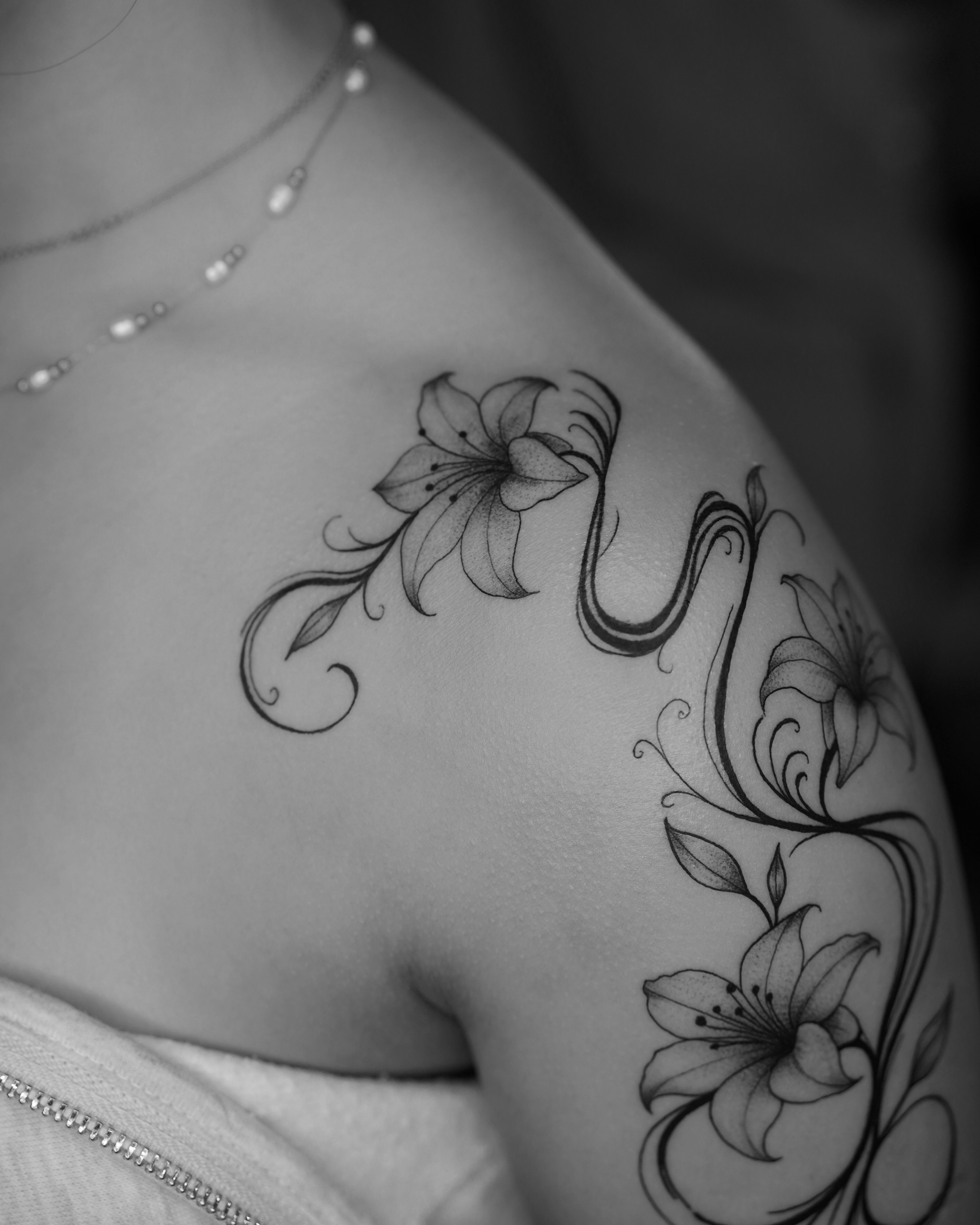
Monochrome botanical vs. Fineline floral: what's the difference
Both styles use black ink. The differences lie in needle configuration and intent. Monochrome botanical realism work uses needle groupings, sometimes a 5 or 7 magnum (a curved cluster used for shading large areas), to build soft tonal gradients that resemble a pencil drawing. The result reads from a distance like a photograph.
Fineline tattooing uses a single needle or a tight 3RL grouping (three round-liner needles soldered in a row) to draw lines no thicker than a human hair. Applied to florals, this produces something closer to a botanical illustration. Wispy. Precise. The kind of piece that rewards close inspection.
Neither approach is easier than the other. They demand different hand speed and pressure calibration. Knowing which one suits your design idea is part of what the consultation is for.
How the Studio Approaches Botanical Work
Consultation: from reference image to original design
Nothing here is pulled from a flash sheet. Every floral piece starts as a blank page. The studio studies botanical photography, macro reference shots, and sometimes dried specimens to understand how a specific flower actually behaves: where its petals overlap, how the light catches its surface, where the darkest shadow sits relative to the stem.
When you bring in references, the artist isn't copying them. They're reading the structure underneath. A handful of images that capture the mood you want. Not necessarily the exact design. Gives the studio enough material to sketch something original that fits your body rather than an imaginary flat canvas.
Stencil placement and body mapping
Stencils on flat paper behave differently once they land on a curved surface like a collarbone or a forearm. If you print a circular floral arrangement at exact scale and wrap it around a shoulder, the top and bottom compress differently. The studio adjusts proportions before printing, elongating certain elements to account for the curve, so the finished piece reads as balanced when you're wearing it rather than just when it's lying flat.
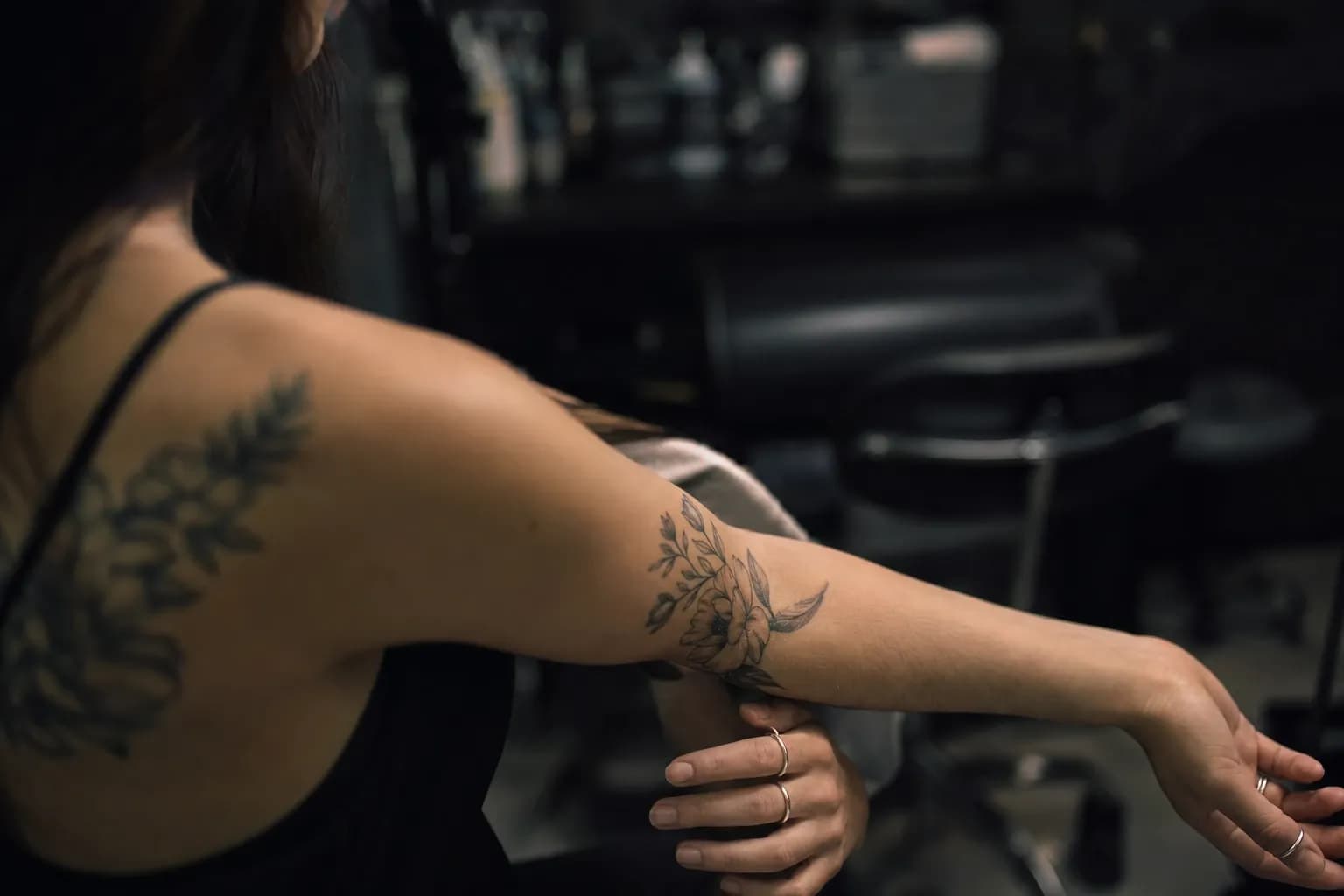
Placement decisions also follow the body's contours deliberately. A stem that runs along the inside of the forearm can follow the line of the ulna bone for structural logic. A floral arrangement on the shoulder can fan outward from the deltoid peak so the piece appears to grow from the body rather than float on it.
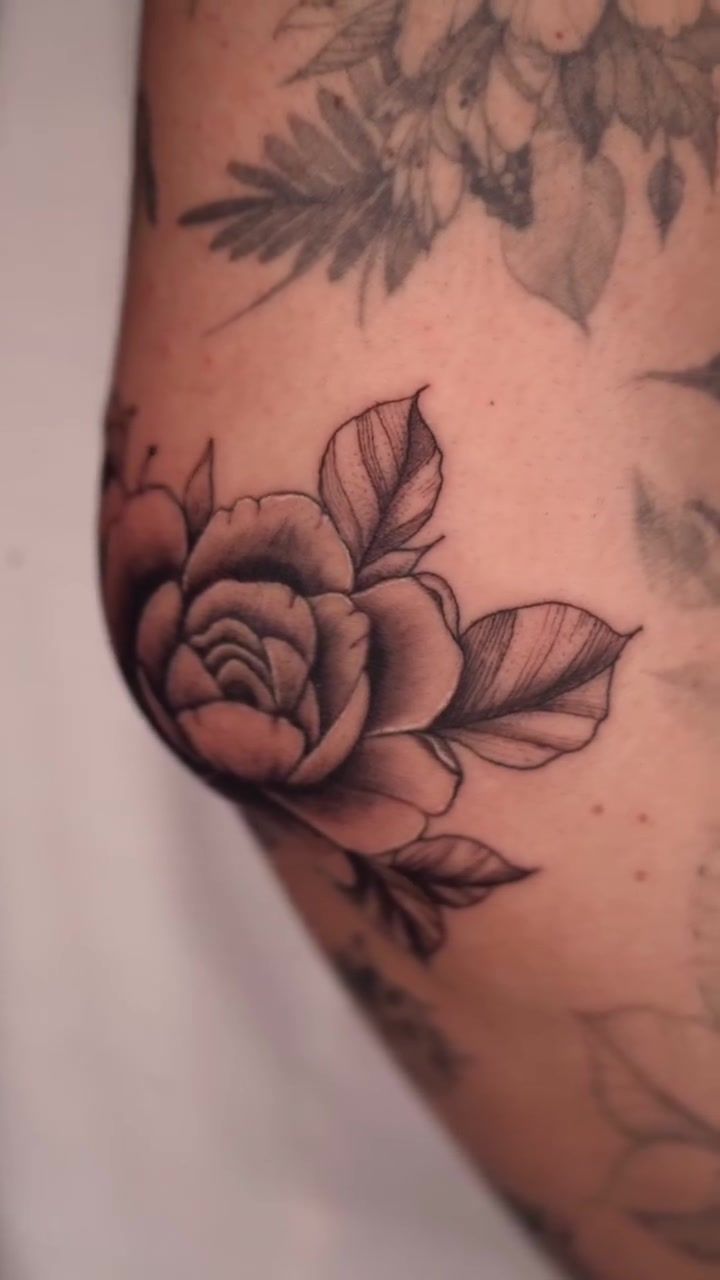
Elbow placement specifically is one of the more technically demanding spots for botanical work. The skin stretches and compresses constantly. The studio accounts for that distortion when drawing the stencil, so the rose reads correctly both when the arm is relaxed and when the elbow is bent.
Placement, Size, and Session Length: What to Plan For
Floral tattoos vary enormously in scope. A single wildflower on the wrist and a full shoulder arrangement are different conversations entirely. The table below gives a practical starting point for planning. All estimates assume a single contained piece, not a sleeve session.
| Placement | Typical session length | Healing considerations |
|---|---|---|
| Outer forearm | 2 to 3 hours | Skin stays taut; holds fine lines well; avoid direct sun during the two-week healing phase |
| Shoulder / upper arm | 2 to 4 hours depending on detail | Generally heals cleanly; good canvas for layered floral arrangements |
| Collarbone / sternum | 2 to 3 hours | Skin is thin; Lisbon's humid summers slow moisture-sensitive healing here |
| Ribs | 2 to 4 hours | High stretch over time; touch-up risk is higher; discuss realistic longevity at consultation |
| Hand / fingers | 1 to 2 hours | Highest fade rate of any placement; needs honest expectations before booking |
Hand and finger florals are consistently the most requested and the most misunderstood placement. The skin there turns over quickly and receives constant friction. If you're considering that area, read through what placement really means for hand and finger tattoos before the consultation. The realities are the same whether you're placing script or botanicals.
For something like the Conch Shell in Bloom, the placement on a stable skin surface is part of why the fineline detail reads so cleanly. That's not accidental. Placement shapes the outcome as much as technique does.
Healing Floral Tattoos in Lisbon's Climate
Lisbon's Atlantic humidity sits noticeably higher between June and September. For most tattoo styles, that's a manageable factor. For thin fineline floral work, it's worth planning around. Humid air means your skin's surface moisture fluctuates more than it would in a drier climate, and over-moisturised healing skin can cause fine lines to blur slightly during the recovery window.
The studio recommends a modified approach for fineline botanical pieces healed during summer: a shorter initial wrap period of around 24 hours, then a controlled dry-healing phase for the first two weeks. That means no swimming, no beach days near Cais do Sodré, and no prolonged sun exposure on the tattooed area. The Tagus riverfront is five minutes away for some clients. It'll wait two weeks.
- Keep the area out of direct sunlight for a minimum of two weeks post-session
- Apply a thin layer of unscented fragrance-free moisturiser once or twice daily. Not heavily, just enough to prevent cracking
- Avoid submerging the tattoo in water (pools, river, sea) until the surface is fully closed
- After healing, use SPF 50 on any sun-exposed floral tattoo to prevent the lines from graying prematurely
- Expect the piece to look slightly bolder and higher-contrast fresh. Fineline florals settle into the dermis over six to eight weeks and take on a softer, more integrated look. This is normal.
For general aftercare principles beyond what the studio provides at your session, NHS guidance on tattoo aftercare offers a useful baseline. And Healthline's tattoo aftercare breakdown covers the practical daily steps in detail.
What Separates a Good Floral Tattoo from a Great One
"Botanical work needs room to breathe. If you pack petals edge to edge, they merge as the skin settles and you lose everything that made the design interesting in the first place. Negative space isn't empty space. It's structure."
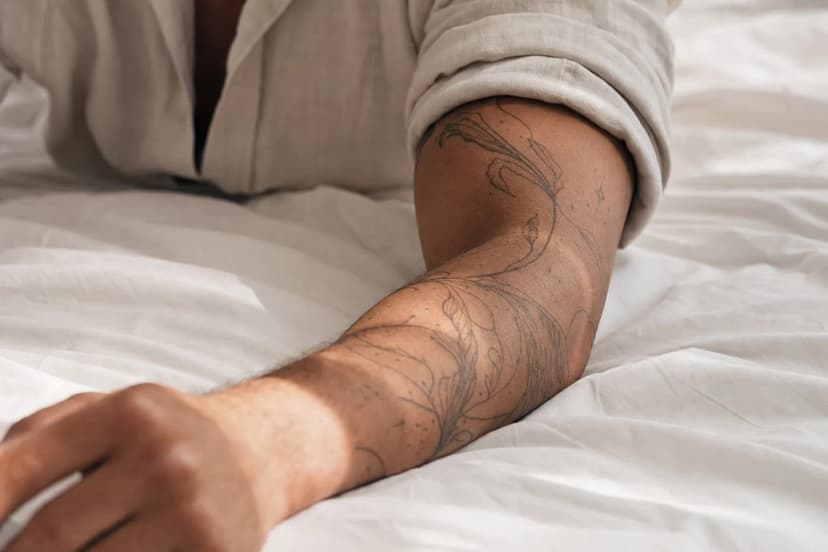
Negative space is the most consistently underused tool in floral tattooing. When too many elements compete for the same area of skin, they read as a single dark shape after healing. The lines that defined each petal individually disappear into each other. A skilled delicate floral tattoo artist builds the composition so each element has room, even if that space is only a millimetre wide.
Line weight hierarchy is the other mark of craft-level botanical work. The stem carries the structural weight of the design, so it uses a slightly heavier line. The outer petal edges use the finest possible line, almost a suggestion. That contrast makes the piece feel dimensional without any shading at all. It's a principle borrowed from botanical illustration and applied directly to skin.
When you're vetting any studio online, look for that hierarchy in their published work. A flat, uniform line weight across stems and petals reads as amateur regardless of how clean the execution is. Here's what to look for when you're evaluating a floral tattoo studio in Lisbon or anywhere else.
- Multiple floral pieces across different placements, not just one or two showpiece images
- Visible variation in line weight between structural elements and petal edges
- Clean negative space that doesn't look accidental. Compositions that breathe
- Healed photos alongside fresh ones, so you can see how the work settles
- Shading gradients inside petals that move smoothly rather than banding into visible stripes
- Designs that follow the body's contour rather than sitting awkwardly flat against it
If a studio's portfolio shows ten florals that all look almost identical in composition and scale, that's a sign of a template approach rather than genuine botanical specialisation. A fineline floral tattoo in Portugal's varied climate and across Lisbon's diverse clientele from Alfama to Príncipe Real should look as individual as the person wearing it.
Frequently Asked Questions
How do I know if a tattoo artist specialises in floral work?
Look at their published portfolio specifically for botanical pieces, not just one or two examples. Check for consistent line weight control, clean petal shading, and negative space management. A genuine specialist will have multiple floral pieces across different placements and scales, not just a single rose tucked between other styles.
Where on the body do floral tattoos age best?
Upper arms, shoulders, and outer forearms tend to hold floral detail well because the skin sits over firm muscle and sees less friction. Ribs and sternum are popular but stretch more over time. Fingers and hands have the highest fade rate and need realistic expectations set before you book.
How long does a floral tattoo session take in Lisbon?
A contained fineline floral on the forearm typically takes two to three hours. A shoulder piece with layered petals and shading can run three to four hours. Full sleeve florals are broken into multiple sessions. The artist will give you a realistic estimate during the consultation once the design scope is clear.
Can floral tattoos be done in colour or only black and grey?
Both are possible, but the studio focuses on monochrome fineline and micro-realism botanical work. Ink-only floral tattoos age more predictably on Lisbon's sun-exposed skin and require fewer touch-ups over time compared to colour, which can shift with UV exposure and changes in skin tone.
What should I bring to a floral tattoo consultation?
Bring five to ten reference images that represent the mood you want, not necessarily the exact design. Real botanical photography, paintings, or even pressed flowers you love all help. Also note any placements you're considering, and bring loose comfortable clothing that gives easy access to the area you have in mind.