Why Geometric Tattoos Demand a Different Kind of Attention
The unforgiving nature of straight lines and perfect circles
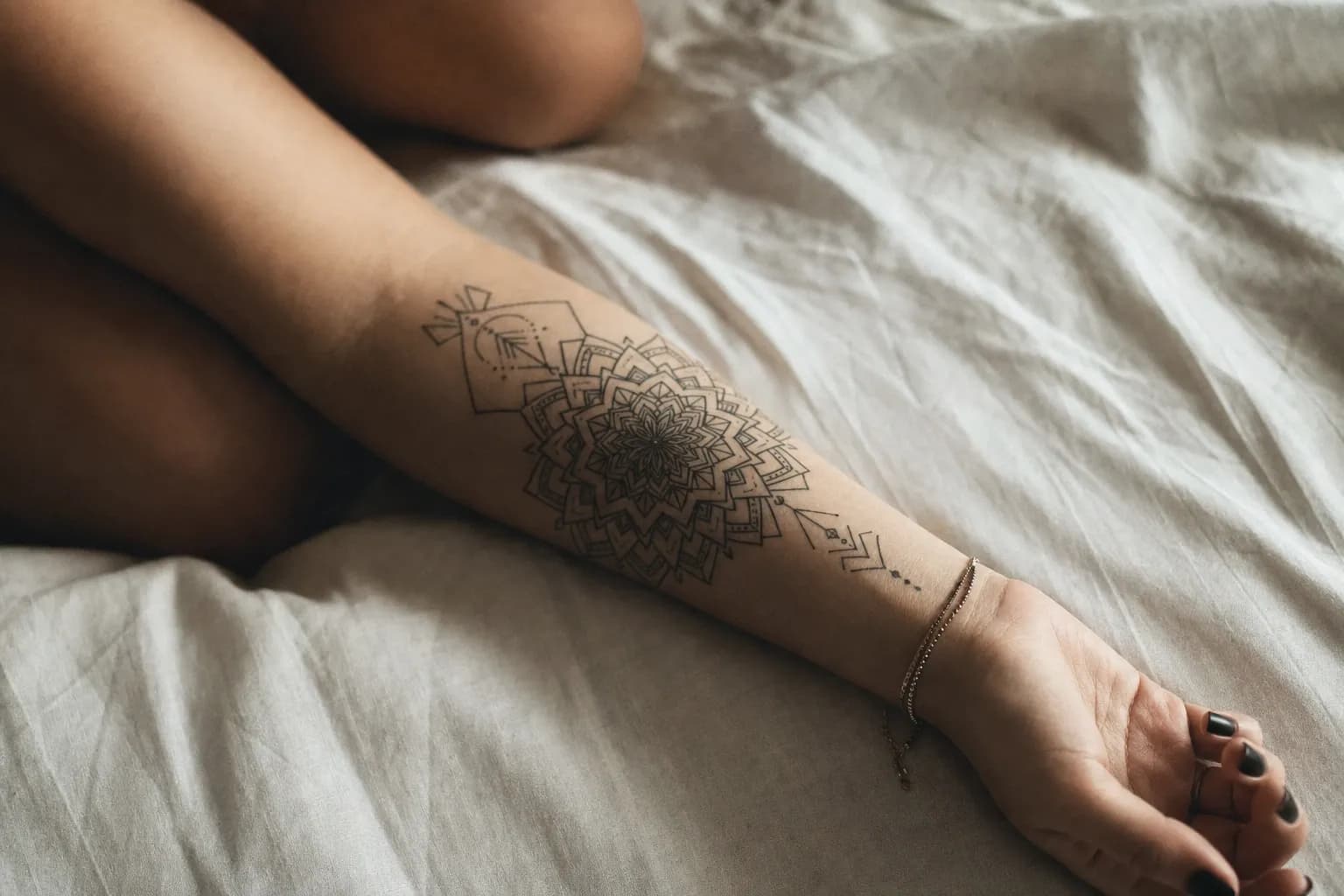
Pick up any floral tattoo and tilt it slightly. The petals adjust. The composition breathes. Now do the same with a mandala. If the stencil sits 2mm off-centre on a forearm, you'll see it every single time you glance down. There's no natural variance to absorb the error. The geometry either holds or it doesn't.
That's the core challenge of this style. Symmetry, stencil accuracy, and needle consistency have to work together from the first mark. One wobble in a concentric ring ripples outward through every subsequent layer.
Lisbon adds its own variables. Summer humidity in the city softens the skin's surface and affects how a stencil transfers and grips. The population here also spans a wide range of skin tones, each requiring slightly different needle pressure and ink saturation to produce clean, readable lines. A good geometric tattoo artist near me isn't just someone with a compass and a steady wrist. It's someone who accounts for all of this before the machine even starts.
What Geometric Tattooing Actually Is
Sacred geometry, mandalas, and architectural line work
Geometric tattooing covers a broad cluster of approaches. Sacred geometry tattoo work draws on mathematical forms. The Flower of Life, Metatron's Cube, the Fibonacci spiral. That carry symbolic weight across cultures. Mandalas build outward from a central point using repeating radial symmetry. Dot-work (tiny individual ink points rather than continuous lines) creates tone and texture inside geometric frameworks. Architectural line work borrows from technical drawing: precise angles, mirrored structures, grid-based compositions.
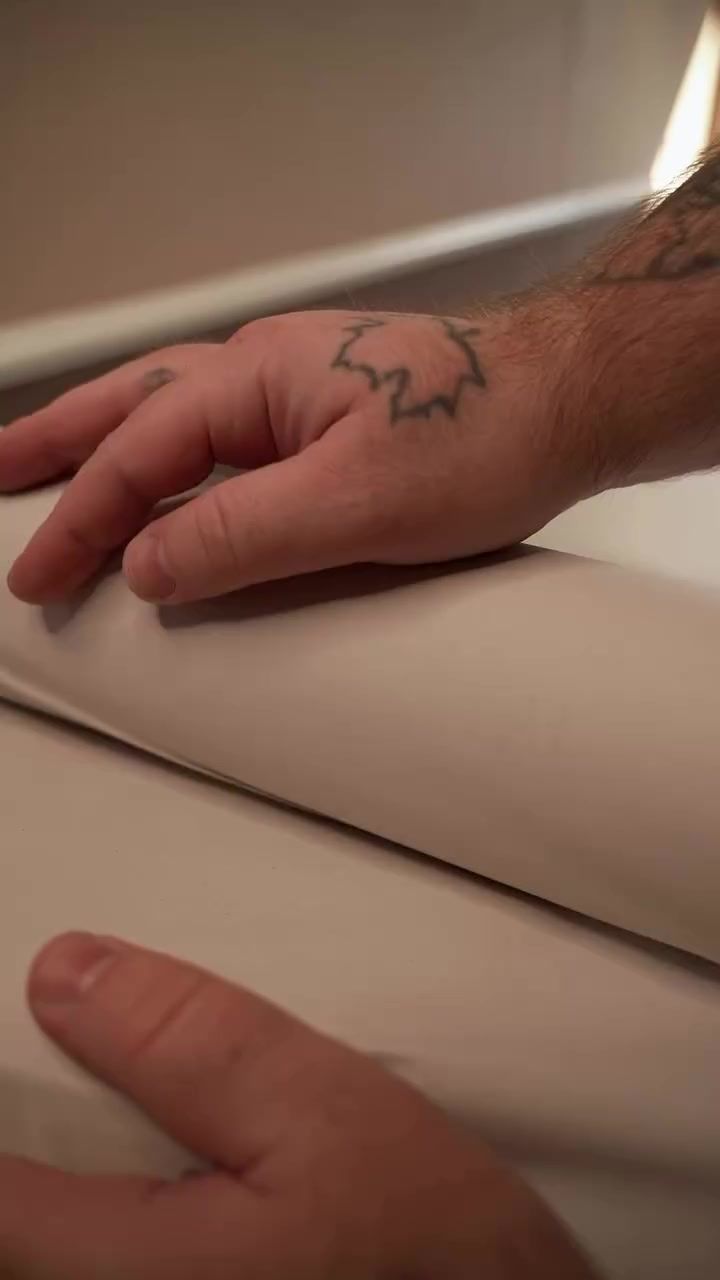
Lisbon has its own deep relationship with geometric pattern. The azulejo tile tradition that covers church facades in Alfama and stairwells in Príncipe Real is built on exactly the same principles: repeating units, mathematical symmetry, precision at small scale. The studio's azulejo-inspired piece shows how that local visual language translates directly onto skin.
Where it fits alongside fineline and micro-realism
Pure geometric work prioritises structure: lines, angles, patterns. But many of the most compelling pieces now live at the intersection of styles. A geometric mandala can enclose a micro-realistic eye at its centre. A portrait can be framed by radiating geometric architecture. When the geometric framework carries fine single-needle linework, it starts to overlap with fineline tattooing, where line weight and delicacy become the whole point.
The studio's geometric tattoo service covers the full range: pure sacred geometry, mandala tattoo work, dot-work compositions, and hybrid pieces that blend geometric structure with realism or fineline detail.
The Craft Behind the Lines: What Separates Good from Exceptional
Stencil placement and skin prep
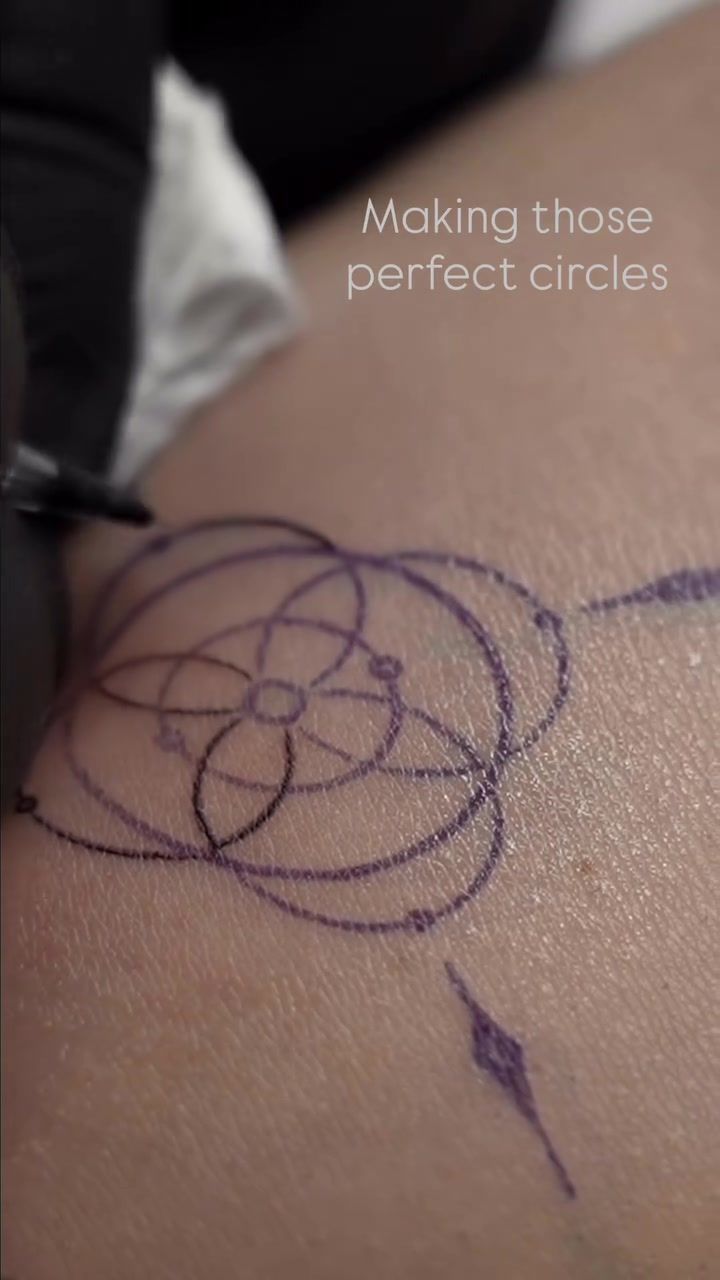
A stencil is the transfer of your design onto the skin before any ink goes in. For organic styles, approximate placement is usually fine. For geometric work, approximate isn't good enough. A mandala's radial symmetry is built around a single centre point. Move that point 1mm, and every concentric ring drifts. By the outermost layer, the misalignment is obvious.
The artist dry-fits the stencil multiple times, checks alignment from several angles, and sometimes uses a reference grid on the body before committing. Skin is not a flat canvas. It curves, it shifts when the arm moves, and it responds differently depending on how hydrated it is that day. All of that gets accounted for before the needle touches skin.
Needle selection and machine settings for line work
Geometric line work generally uses tight liner configurations: single needles for the finest lines, or a three-needle tight liner for slightly heavier outlines. The machine runs at a lower voltage than you'd use for shading, favouring control over speed. Dot-work uses a single needle at a slower pace, placing each point deliberately.
Contrast matters too. A mandala tattoo artist in Lisbon working across varied skin tones needs to calibrate ink density carefully. A line that reads crisp on one person's skin can look grey and diffuse on another if the pass count isn't adjusted.
Why session length matters more than people expect
Hand fatigue is real. After about 90 minutes of sustained geometric work, even a very experienced artist's line consistency starts to shift slightly. The solution isn't pushing through. It's building in short breaks during long sessions.
A clean geometric forearm piece typically takes three to four hours minimum. A full-detail mandala covering the upper arm runs four to six hours, sometimes split across two sessions. Compressing that into less time to save money or fit a tighter schedule nearly always shows in the finished work.
"Preparation is most of the work. By the time the needle starts, the design, the placement, the skin, and the stencil should all be exactly right. What follows is execution, not improvisation."
How the Studio Approaches Geometric Work in Lisbon
The consultation: translating your idea into a buildable design
Every geometric piece at the studio starts with a proper conversation, not a quick message exchange. The artist wants to understand not just what you want to see, but where it's going on your body, how large it needs to be to hold its detail, and what the piece needs to mean to you.
Reference images help enormously. Bring anything that speaks to you, even if it's a photograph of azulejo tiles, a page from a geometry textbook, or a screenshot from an architecture book. The artist won't copy another tattoo. But references communicate visual language faster than words, and they anchor the design conversation in something concrete.
The final design is always original. The studio sketches directly for your body, your skin, your placement. What you bring in is a starting point, not a template.
Hybrid designs. When geometry meets realism or fineline
Some of the most striking work in the portfolio sits at the boundary between styles. Geometric architecture can hold figurative imagery inside it without either element compromising the other. The key is building the geometric framework first, in both the design and the tattooing sequence, so the internal imagery has a structure to sit within rather than competing against it.
Icarus in Geometric Architecture shows exactly this: a mythological figure rendered with micro-realistic detail, enclosed by precise geometric scaffolding that gives the piece its formal weight. The geometry and the figure read as one composition, not two things placed next to each other.
For placement, the studio generally steers geometric work toward the outer forearm, upper arm, and back. These are the most stable skin surfaces, particularly in Lisbon's warm climate where sun-exposed limbs need aftercare discipline. If you're spending summer afternoons in Alfama or cycling through Príncipe Real, your aftercare routine needs to be consistent.
If you're drawn to single-needle precision as part of a hybrid piece, the studio's approach to fineline tattooing informs how those finer elements are handled within the geometric framework. It's worth reading about the two styles together before your consultation. For a sense of how precision translates across different styles, the guide on what great lettering actually takes covers similar ground from a different angle.
Placement, Sizing and Healing: Practical Realities
Choosing the right placement for geometric designs
Not every part of the body holds geometric line work equally well over time. High-movement areas cause fine lines to blur faster. Flatter, lower-movement surfaces give the lines room to settle cleanly into the dermis (the stable layer of skin below the surface) and stay readable for years.
| Placement | Line longevity | Recommended minimum size | Notes |
|---|---|---|---|
| Outer forearm | Excellent | 6 cm across | Stable canvas, easy to photograph |
| Upper arm | Excellent | 7 cm across | Good for larger mandalas and wraps |
| Back / shoulder blade | Very good | 10 cm across | Ideal for large sacred geometry pieces |
| Calf | Good | 7 cm across | Slight skin elasticity; works well mid-calf |
| Inner wrist | Moderate | 4 cm max | Flexion causes lines to soften faster |
| Fingers / hands | Poor for fine lines | Simple bold lines only | Not recommended for detailed geometric work |
| Ribcage / sternum | Good | 8 cm across | Skin moves with breathing; plan composition accordingly |
Healing geometric tattoos in Lisbon's climate
Lisbon summers are long, bright, and humid. That combination affects healing in ways that clients from cooler climates sometimes don't anticipate. High ambient humidity slows the drying stage of healing, which means the surface can stay slightly moist longer than ideal. Fine geometric lines need that surface to dry cleanly to avoid ink migration during early healing.
Sun exposure is the bigger risk. The UV intensity in outdoor Lisbon neighbourhoods like Alfama and Cais do Sodré in July and August is significant. Fresh tattoo ink sitting under thin healing skin and direct sun is a reliable way to fade a precise geometric piece prematurely. Keep it covered or indoors during peak UV hours for at least the first three weeks.
Here's a practical aftercare sequence for geometric work in Lisbon's conditions:
- First 48 hours: Keep the tattoo covered with a breathable film bandage. Don't submerge it. Wash gently with fragrance-free soap twice daily and pat dry.
- Days 3 to 7: Apply a thin layer of unscented moisturiser (a pea-sized amount) two to three times a day. The skin will begin to peel. Don't pick it. Peeling pulls ink from geometric lines in patches.
- Weeks 2 to 4: The surface looks healed. It isn't fully. Keep moisturising daily and avoid prolonged sun exposure. Use SPF 50 over the area if it will be exposed.
- Weeks 5 to 8: The deeper layers of skin are still settling. Fine geometric lines may look slightly hazy during this window. That's normal. Don't assess the final result yet.
The studio recommends waiting a full eight weeks before assessing whether a touch-up is needed. Fine lines often clarify considerably between week four and week eight as the skin finishes healing. Coming in earlier for a touch-up almost always means re-healing work that would have resolved on its own.
Before your session, prepare your skin properly:
- Moisturise the placement area daily for at least one week before the appointment.
- Avoid sun exposure on the target skin for at least seven days prior.
- Arrive well-rested and having eaten a proper meal. Low blood sugar makes skin more reactive.
- Wear or bring clothing that gives easy, unrestricted access to the placement area.
- Don't apply lotion or body oil on the day of the session. The stencil needs clean, dry skin to transfer accurately.
Frequently Asked Questions
How long does a geometric tattoo take to complete?
A small geometric piece (roughly palm-sized) typically takes two to three hours. A detailed mandala or full forearm composition usually runs four to six hours, sometimes split across two sessions. Rushing line work causes wobble and uneven spacing, so the artist won't compress a complex piece into too little time.
Do geometric tattoos age well?
Clean, precise line work holds well when placed on low-movement areas like the outer forearm or upper arm. Fine lines can soften slightly over years, but well-executed geometric pieces remain legible for decades. Sun protection and proper initial healing are the two biggest factors in long-term clarity.
Can a geometric tattoo be combined with realism or fineline?
Yes, and it's one of the more interesting directions in contemporary tattooing. Geometric frameworks can enclose a realistic portrait, or fine single-needle lines can build a mandala with real delicacy. The studio works regularly in this hybrid space, as pieces like Icarus in Geometric Architecture show.
What is the minimum size for a detailed geometric mandala?
A mandala tattoo with meaningful internal detail needs at least eight to ten centimetres in diameter to hold its geometry cleanly after healing. Smaller than that and concentric rings begin to merge as the skin heals. The artist will advise on the right sizing during your consultation based on chosen placement.
How should I prepare for a geometric tattoo session in Lisbon?
Arrive well-rested and fed. Wear clothing that gives easy access to the placement area. If your session is in summer, avoid heavy sun exposure on the target skin for at least a week beforehand. Moisturised, healthy skin takes a stencil more accurately and holds ink more evenly from the first pass.
Does placement affect how geometric lines hold over time?
Significantly. High-movement areas like fingers, inner wrists, and elbows cause fine lines to blur faster due to constant skin flexion. Flatter, lower-movement surfaces such as the outer forearm, upper arm, calf, or back provide a more stable canvas and give geometric line work its best long-term result.