Why "Near Me" Is the Wrong Filter to Start With
When people search for realism tattoo shops near me, the instinct makes sense. Convenience matters. But proximity is almost irrelevant if the artist can't execute the style properly, and realism is the style where that gap shows most brutally.
A realism tattoo attempts to replicate a photograph on skin. Every error is visible. A portrait with flat shading looks like a sketch, not a face. A landscape without tonal depth looks like a smudge. You'll live with the result every day.
A thirty-minute metro ride across Lisbon to the right studio is nothing compared to a botched portrait you'll wear for decades. The real question isn't where the studio is. It's how you identify genuine realism skill, wherever the studio happens to sit.
What Realism Tattooing Actually Is
Realism, at its most precise definition, means translating depth, shadow, highlight, and texture onto skin so convincingly that the eye reads it as three-dimensional. If you've seen a portrait tattoo that looked like a photograph, that's the goal. If you've seen one that looked like a stamped image losing its ink, that's what poor technique produces.
The style demands more than good drawing ability. It requires understanding how skin accepts ink at different depths, how pigment spreads over weeks of healing, and how tonal gradients need to be slightly exaggerated during application to land where you want them once healed. For a deeper look at what that technical process involves, the guide on what realism tattooing actually requires covers the craft in detail.
Black and Grey vs Colour Realism
Black and grey realism builds its depth through ink dilution. The artist mixes distilled water with black ink to create a full spectrum of grey tones, from near-black shadows to pale, barely-there highlights. The studio focuses primarily on black and grey realism, because the tonal control required suits the precision-first approach that runs through every style offered here.
Colour realism adds chromatic complexity on top of that tonal foundation. It demands a wider pigment vocabulary and an understanding of how colours shift as they heal. Both approaches share the same core demand: the full tonal range must be present, or the piece falls flat.
Scale and What It Changes
A palm-sized portrait and a full-sleeve realism piece are technically different projects. At small scale, the artist has almost no room for correction. Every needle pass counts. That's the territory of micro realism, where photorealistic detail is packed into a piece smaller than a playing card. You can read more about that specific discipline in the guide to micro realism tattoos in Lisbon.
At larger scale, the challenge shifts to consistency. A back piece built across six sessions needs the same tonal range in session six as it had in session one. That requires a single artist who knows their own work intimately, not a rotating team.
How to Evaluate a Realism Portfolio Before You Book
Portfolio review is where most clients make their first mistake. They look at the overall impression rather than the specific technical evidence. Here's what to look for instead.
Tonal Range and Contrast
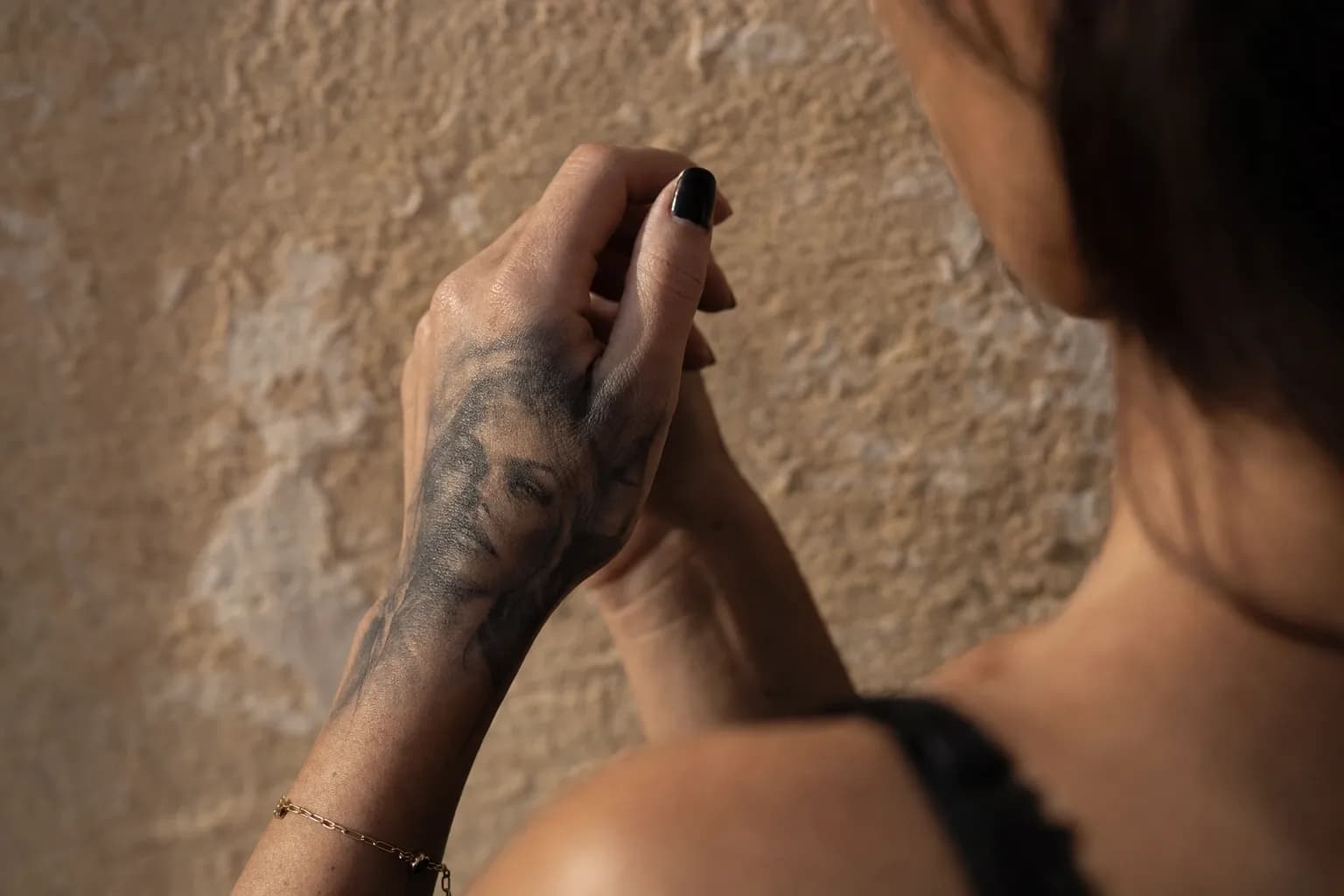
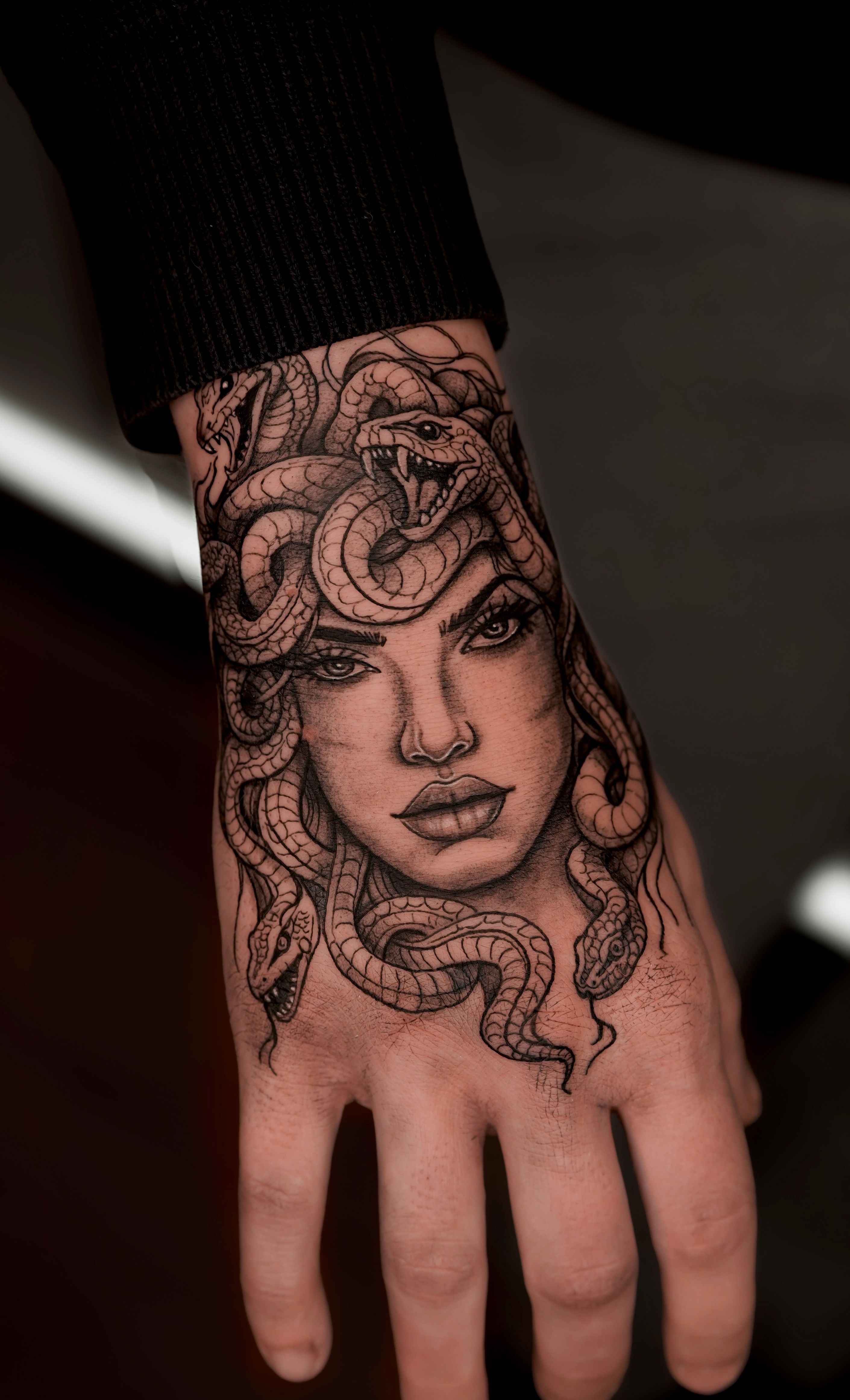
Look for work that moves from deep, saturated black through a full spectrum of greys to a bright, clean highlight. If everything sits in the mid-grey range, the piece will read as flat regardless of how technically clean the lines are. A good black and grey realism tattoo in Lisbon should have the same contrast you'd expect from a well-exposed photograph.
In the Medusa piece above, notice how the darkest areas anchor the shadows while the skin itself creates the brightest highlights. That's controlled technique, not luck.
Edge Work and Skin Breaks
Look closely at faces and fine textures. The edges around eyes, lips, and hair strands should be controlled, not blurry. Blurry outlines on a photorealistic tattoo artist's portfolio usually indicate inconsistent needle speed or pressure during application. Once healed, those edges don't sharpen; they stay soft.
Skin breaks are harder to spot: they're gaps in shading where the needle missed a pass. They can be invisible in fresh photos under studio lighting. This is why healed work matters.
Healed Work vs Fresh Photos
Fresh tattoos look vivid under good lighting. Healed tattoos tell the truth. When evaluating any studio, ask specifically to see healed results, ideally pieces that are at least three months old. A studio confident in its work will have them ready.
Consistency across subjects also tells you something. Two or three strong portraits might be the artist's best days. Ten to fifteen strong portraits across different subjects, placements, and scales means the skill is repeatable.
What the Consultation Should Tell You
The consultation is your clearest signal of whether a studio actually understands realism or just offers it. A photorealistic tattoo artist who knows their craft will ask questions before they agree to anything.
They'll ask about your reference images, and then they'll push back on some of them. A reference that works perfectly as a photo might not translate to skin at the size you want. That conversation, the refinement of what's possible versus what you imagined, is a good sign. An artist who says yes to everything without discussion is either overconfident or indifferent.
Placement is a serious technical conversation in realism work. The body's curves create perceived distortion. A face tattooed on the outer bicep reads differently when the arm hangs naturally versus when it's flexed. Skin texture near joints stretches and contracts constantly. A skilled artist discusses all of this before the stencil touches your skin.
For large pieces, session planning matters as much as the design itself. Lisbon's humid summers can slow healing. The studio accounts for seasonal timing when mapping out a multi-session project, because trying to tattoo over skin that hasn't fully settled produces muddy results.
"The difference between a realism piece that stays sharp for fifteen years and one that turns to grey soup by year three is almost never the ink. It's whether the tonal structure was built correctly in the first place, and whether the client gave the skin the time it needed between sessions."
Placement, Sizing, and Session Planning for Realism
Realism has real minimum size requirements. A portrait face needs at least eight to ten centimetres of vertical space for the detail to survive long-term. Any smaller and the fine gradients compress into each other as the skin heals. This is especially true for facial features: eyes, lips, and hair texture need room to breathe.
Below is a practical reference for common realism placements, the typical session time involved, and how each location affects long-term longevity.
| Placement | Typical Session Length | Longevity Considerations |
|---|---|---|
| Upper arm / bicep | 3-5 hours (single piece) | Good stability; low friction, moderate sun exposure |
| Forearm | 2-4 hours | Sun exposure fades contrast faster; sleeve clothing helps |
| Back (full or half) | Multiple sessions, 4-6 hours each | Excellent longevity; low friction, easy to protect from sun |
| Thigh | 3-5 hours | Stable skin, heals well; inner thigh fades faster due to friction |
| Hand / fingers | 1-3 hours | High friction and sun exposure; touch-ups more likely over time |
| Ribcage | 2-4 hours | Skin movement during breathing adds healing complexity |
For a first realism piece, the upper arm and thigh are the studio's most recommended placements. The skin is stable, the healing is predictable, and there's enough flat area to give the design room to read properly.
Before your session, prepare your skin with a few practical steps:
- Moisturise the area daily for at least one week before the appointment (well-hydrated skin accepts ink more evenly)
- Avoid sun exposure on the placement area for at least two weeks prior
- Eat a proper meal within two hours of your session start time
- Wear or bring clothing that gives clear, comfortable access to the placement
- Avoid alcohol for at least 24 hours before your appointment
Aftercare for a large realism piece in Lisbon's climate deserves attention. Lisbon summers are humid, and humidity can slow the surface healing of a large tattooed area. The studio provides specific aftercare instructions after each session. In general terms, keeping the piece covered and moisturised for the first week, avoiding direct sun, and not submerging the area in pools or the sea for at least three weeks gives the ink its best chance to settle cleanly.
How the Studio Approaches Realism in Lisbon
The studio operates as a single-artist practice. That decision is deliberate. For a multi-session realism piece, consistency of needle depth, pressure, and tonal approach across every sitting is not optional. It determines whether the piece coheres as one unified work or reads as a series of disconnected sessions. There are no hand-offs here.
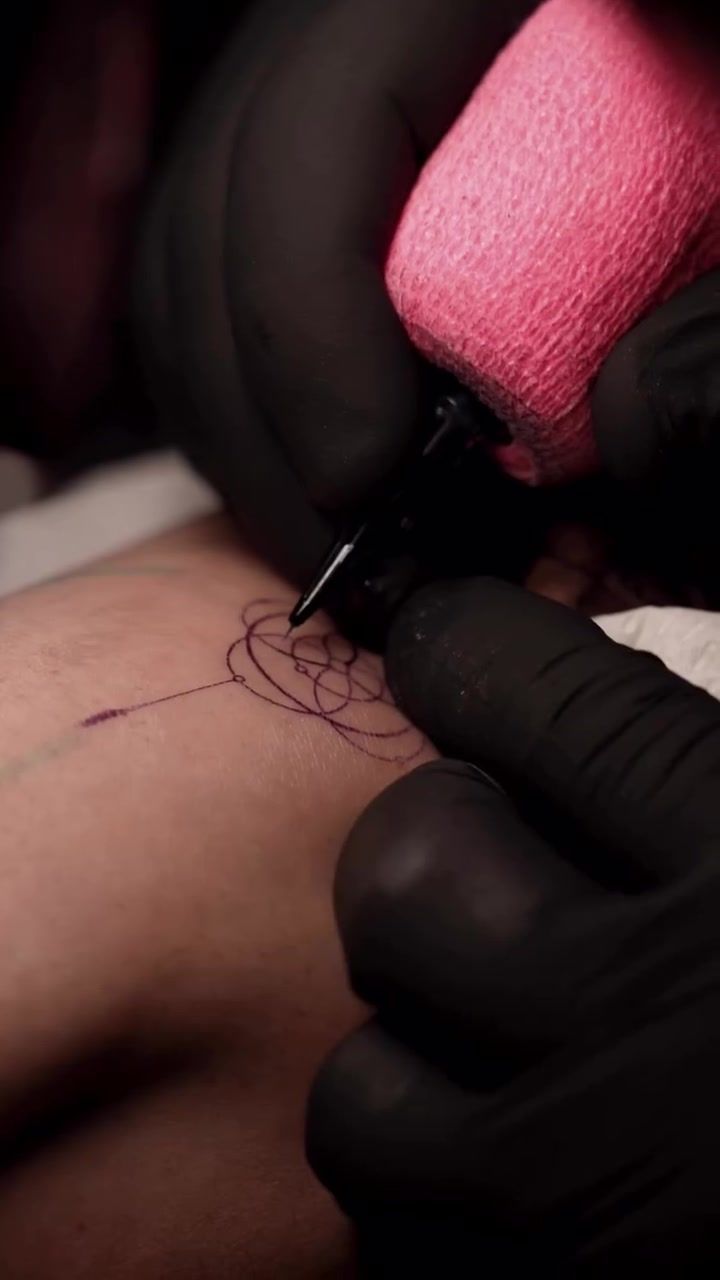
The process for every realism project starts with reference gathering. The artist reviews what you bring, identifies what will and won't translate to skin at your chosen size and placement, and proposes adjustments where needed. A digital sketch follows. Then stencil placement, which the artist checks from multiple angles before asking for your approval. The needle doesn't move until you're satisfied with the positioning.
The studio is located in central Lisbon, accessible from Cais do Sodré and walkable from Lapa and Príncipe Real. The Cais do Sodré metro station puts you a short walk away, which makes attending multiple sessions over the course of a large project straightforward if you're coming from across the city or visiting from elsewhere in Portugal.
If you're considering a realism piece and want to understand what the style can offer at its full range, the studio's realism service page covers the approach in detail. And if you're weighing realism against a smaller-scale option, the portfolio includes work across multiple scales, from large back pieces to compact portrait work that sits closer to the micro realism end of the spectrum.
When preparing for a portrait session specifically, bring the following:
- Multiple high-resolution reference images of the subject, ideally from more than one angle
- Any mood references showing lighting or atmosphere you're drawn to
- A clear sense of your preferred placement and the size you have in mind
- An honest timeline, including any travel plans or events where you'd want healing to be complete
Frequently Asked Questions
How long does a realism tattoo take to complete?
Scale decides everything. A palm-sized portrait typically needs one session of three to four hours. A half-sleeve realistically requires two or three sittings across several weeks, with healing time built in between. Large back pieces are multi-month projects. The studio maps out a realistic timeline during the initial consultation, before any commitment is made.
Do realism tattoos fade faster than other styles?
Realism relies on subtle tonal gradients rather than bold outlines, so poor technique or improper aftercare can cause it to lose contrast over time. Placement matters too: areas with high friction or sun exposure fade faster. Proper aftercare and annual touch-ups when needed keep a well-executed realism tattoo in Lisbon looking sharp for many years.
What's the difference between realism and micro realism?
Realism operates at full or near-full scale: portraits, nature scenes, large figurative work. Micro realism packs photorealistic detail into a piece typically smaller than a playing card. The techniques overlap, but micro realism demands finer needles, tighter control, and often a single-pass approach to avoid overworking a small area of skin. The guide to micro realism tattoos in Lisbon covers the distinction in depth.
How do I know if a Lisbon studio genuinely specialises in realism?
Ask to see healed work, not just fresh photos. Look for a full tonal range from deep black to bright highlight, controlled edges on faces and textures, and consistent quality across multiple subjects. A studio that shows only one or two realism pieces likely treats it as a side offering. The best realism tattoo studio in Lisbon will have a deep, consistent body of work ready to review.
What should I bring to a realism tattoo consultation?
Bring several high-resolution reference images. Multiple angles of a portrait subject help the artist understand the full form, not just a single view. Come prepared to discuss placement, sizing, and your timeline. If the artist pushes back on certain references or suggests adjustments, treat that as a good sign. It means they're thinking about what will actually work on skin.